• Request Info
  • Visit
  • Apply
  • Give
  • Request Info
  • Visit
  • Apply
  • Give

Search

  • A-Z Index
  • Map

Ecology & Evolutionary Biology

  • About
    • Give to EEB
    • Alumni
  • People
    • Faculty
    • Emeritus
    • Graduate Students
    • Adjunct
    • Postdocs
    • Research Staff
    • Administrative Staff
  • Undergraduate Students
    • EEB Concentration in Biology
    • EEB Minor
    • Honors
    • Course Descriptions
    • Naturalists Club
    • Fellowships
    • Be successful in EEB
  • Graduate Students
    • Graduate Student Handbook
    • FAQs
    • Applying to Grad School
    • GREBE
    • Funding
  • Research and Outreach
    • Research Highlights
    • Undergraduate Research Opportunities
    • Outreach Events
  • Collections and Facilities
    • UT Herbarium
    • UT Etnier Ichthyology Collection
    • Hesler Biology Greenhouses
    • Natural History Collections Course
    • Fellowships and Awards
    • Biology Field Station
  • News & Seminars
    • Current Seminars
    • News
    • Newsletter
Home » Archives for wpeeb » Page 40
Author: wpeeb

Gavrilets’ work on monogamy featured in Slate

October 10, 2012 by wpeeb

UTK Distinguished Professor Sergey Gavrilets’ work on the evolution of monogamy, published in PNAS, has been featured in an article in the online magazine Slate. In his model, low-ranked males begin providing resources to females, who begin selecting them rather than higher-ranked males. Such behavior then becomes optimal for males higher and higher up the hierarchy.

Filed Under: faculty, Gavrilets, MAIN, outreach, PNAS, popular media, slate

Gavrilets’ work on monogamy featured in Slate

October 10, 2012 by wpeeb

UTK Distinguished Professor Sergey Gavrilets’ work on the evolution of monogamy, published in PNAS, has been featured in an article in the online magazine Slate. In his model, low-ranked males begin providing resources to females, who begin selecting them rather than higher-ranked males. Such behavior then becomes optimal for males higher and higher up the hierarchy.
Filed Under: faculty, Gavrilets, MAIN, outreach, PNAS, popular media, slate

Bats go where the food is

September 18, 2012 by wpeeb

A recent paper in PLOS ONE by dept. head Gary McCracken and colleagues, including former UTK EEB grad students Veronica Brown and Paula Federico, as well as UTK postdoc Melanie Eldridge, analyzed insect DNA in bat feces. Their work suggests that bats change foraging locations to match prey abundance. It also supports previous researchers’ findings that bats contribute substantially to agriculture, providing services that can amount to 12% of the value of a crop.

Abstract: 
The role of bats or any generalist predator in suppressing prey populations depends on the predator’s ability to track and exploit available prey. Using a qPCR fecal DNA assay, we document significant association between numbers of Brazilian free-tailed bats (Tadarida brasiliensis) consuming corn earworm (CEW) moths (Helicoverpa zea) and seasonal fluctuations in CEW populations. This result is consistent with earlier research linking the bats’ diet to patterns of migration, abundance, and crop infestation by important insect pests. Here we confirm opportunistic feeding on one of the world’s most destructive insects and support model estimates of the bats’ ecosystem services. Regression analysis of CEW consumption versus the moth’s abundance at four insect trapping sites further indicates that bats track local abundance of CEW within the regional landscape. Estimates of CEW gene copies in the feces of bats are not associated with seasonal or local patterns of CEW abundance, and results of captive feeding experiments indicate that our qPCR assay does not provide a direct measure of numbers or biomass of prey consumed. Our results support growing evidence for the role of generalist predators, and bats specifically, as agents for biological control and speak to the value of conserving indigenous generalist predators.

Filed Under: bats, graduate, MAIN, McCracken, plos one, postdoc

The importance of managing exotic invasive plants

September 5, 2012 by wpeeb

UTK EEB grad student Sara Kuebbing was recently featured in a podcast by the Ecological Society of America. See more information at The importance of managing exotic invasive plants.

Filed Under: graduate, invasive, MAIN

Evolution and Bullying

August 20, 2012 by wpeeb

UTK Distinguished Professor of Ecology & Evolutionary Biology and Mathematics Sergey Gavrilets recently published a paper in PNAS on the evolutionary origins of egalitarianism.  It shows why individuals may be selected for interfering in a conflict between a bully and a victim on the side of the victim.

Abstract:
The evolutionary emergence of the egalitarian syndrome is one of the most intriguing unsolved puzzles related to the origins of modern humans. Standard explanations and models for cooperation and altruism—reciprocity, kin and group selection, and punishment—are not directly applicable to the emergence of egalitarian behavior in hierarchically organized groups that characterized the social life of our ancestors. Here I study an evolutionary model of group-living individuals competing for resources and reproductive success. In the model, the differences in fighting abilities lead to the emergence of hierarchies where stronger individuals take away resources from weaker individuals and, as a result, have higher reproductive success. First, I show that the logic of within-group competition implies under rather general conditions that each individual benefits if the transfer of the resource from a weaker group member to a stronger one is prevented. This effect is especially strong in small groups. Then I demonstrate that this effect can result in the evolution of a particular, genetically controlled psychology causing individuals to interfere in a bully–victim conflict on the side of the victim. A necessary condition is a high efficiency of coalitions in conflicts against the bullies. The egalitarian drive leads to a dramatic reduction in within-group inequality. Simultaneously it creates the conditions for the emergence of inequity aversion, empathy, compassion, and egalitarian moral values via the internalization of behavioral rules imposed by natural selection. It also promotes widespread cooperation via coalition formation.

It has also garnered widespread press coverage:

Los Angeles Times: Evolution stands up to bullies
http://www.latimes.com/news/science/sciencenow/la-sci-sn-stop-bullying-20120813,0,7921942.story?track=rss
 
Health: Fight the Power: Standing Up to Bullies Benefits Us All
http://news.health.com/2012/08/13/standing-up-to-bullies-benefits-society-study-suggests/
 
Knoxville New Sentinel: Science and bullying: Why we are programmed to help others
 
Tennessee Today: UT, NIMBioS Study Finds Bullies Squelched When Bystanders Intervene
http://www.utk.edu/tntoday/2012/08/13/ut-nimbios-study-bullies-squelched/
 
Decoded Science "Egalitarian Drives as a Response to Bullying"
https://evolution-institute.org/egalitarian-drives-as-a-response-to-bullying/

Discover Magazine: Against the Übermensch 
http://blogs.discovermagazine.com/gnxp/2012/08/against-the-ubermensch/
 
Examiner.com: Bullying intervention is genetically evolutionary 'right thing to do’
http://www.examiner.com/article/bullying-intervention-is-genetically-evolutionary-right-thing-to-do
 
United Press International: Fighting bullies pushed evolution
http://www.upi.com/Science_News/2012/08/14/Study-Fighting-bullies-pushed-evolution/UPI-73181344980881/?spt=hs&or=sn

Piteå-Tidningen (Sweden): Thus arose the sense of equality
 
French Tribune: Standing against Bullying is in Genes 
 
Folha de S. Paulo (Brasil): O altruísmo egoísta
http://teoriadetudo.blogfolha.uol.com.br/2012/08/14/o-altruismo-egoista/
 
Korea Herald: Fighting bullies pushed evolution
http://view.koreaherald.com/kh/view.php?ud=20120815000175&cpv=0

??? ??????? (Russia): ????????? ?????? ???????????? ????? ??????? ?????????????? ????????
http://www.ria.ru/science/20120813/722911416.htm

bigmir.net (Ukrain):   ??????? ?????????????? ????????? ? ???????? ? ???? ???????? – ?????????
http://techno.bigmir.net/discovery/1523403-Chyvstvo-spravedlivosti-razvilos-y-cheloveka-v-hode-evolucii—matematik

Filed Under: Gavrilets, MAIN, math, modeling, PNAS

Study on teaching highlighted by Science

June 22, 2012 by wpeeb

Recent work by grad student Denise Kendall and assistant professor Beth Schussler was selected as an Editors’ Choice by Science. 


Article abstract: Graduate teaching assistants (GTAs) are used extensively as instructors in higher education, yet their status and authority as teachers may be unclear to undergraduates, to administrators, and even to the GTAs themselves. This study explored undergraduate perception of classroom instruction by GTAs and professors to identify factors unique to each type of instructor versus the type of classes they teach. Data collection was via an online survey composed of subscales from two validated instruments, as well as one open-ended question asking students to compare the same class taught by a professor versus a GTA. Quantitative and qualitative results indicated that some student instructional perceptions are specific to instructor type, and not class type. For example, regardless of type of class, professors are perceived as being confident, in control, organized, experienced, knowledgeable, distant, formal, strict, hard, boring, and respected. Conversely, GTAs are perceived as uncertain, hesitant, nervous, relaxed, laid-back, engaging, interactive, relatable, understanding, and able to personalize teaching. Overall, undergraduates seem to perceive professors as having more knowledge and authority over the curriculum, but enjoy the instructional style of GTAs. The results of this study will be used to make recommendations for GTA professional development programs.

Filed Under: education, graduate, MAIN, Schussler, Science

Hunting for aliens

May 29, 2012 by wpeeb

UTK EEB PhD student Sara Kuebbing was recently featured in the Knoxville News Sentinel for her work as part of the Tennessee Exotic Plant Pest Council. She uses an iPad app to identify and track species that are invading the US from elsewhere, typically after introduction by humans. Such species can dramatically affect functioning of ecosystems: examples in the United States include kudzu, zebra mussels, and pythons.

Filed Under: citizen science, graduate, invasive, MAIN, media, News Sentinel, newspaper

EEB grad students and NIMBioS staff meet with Sen. Corker staff

May 3, 2012 by wpeeb

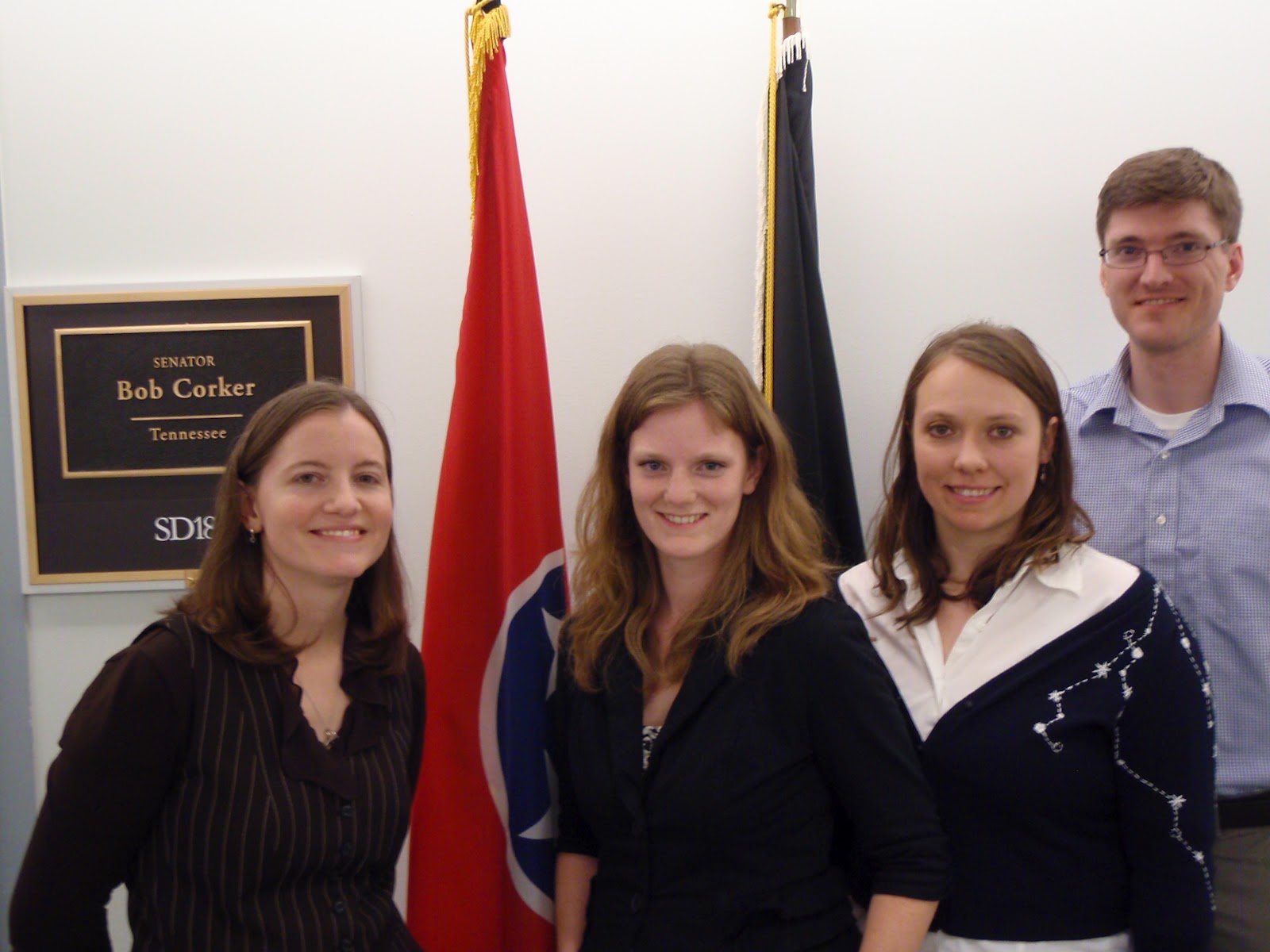
 (From left) Kelly Sturner (NIMBioS), Jessica Bryant (EEB), and Emily Austin (EEB) met with Hunter Bethea, a legislative assistant of Sen. Corker.

(From left) Kelly Sturner (NIMBioS), Jessica Bryant (EEB), and Emily Austin (EEB) met with Hunter Bethea, a legislative assistant of Sen. Corker.

Ecology & Evolutionary Biology (EEB) Department graduate students Emily Austin and Jessica Bryant along with Kelly Sturner, NIMBioS Education & Outreach Coordinator, were invited to visit the office of U.S. Sen. Bob Corker (R-TN) to talk about NIMBioS’ and EEB’s involvement in the USA Science & Engineering Festival. The group spoke with Hunter Bethea, legislative assistant to Corker, about how participation in federally-supported science education and outreach programs, such as NSF research experiences for undergraduates and Department of Energy education programs, led them to pursue science careers, and now inspire them to give back through participating in science outreach.

Filed Under: Classen, corker, graduate, MAIN, NIMBioS, outreach

EEB/NIMBioS at USA Science and Engineering Festival

May 3, 2012 by wpeeb

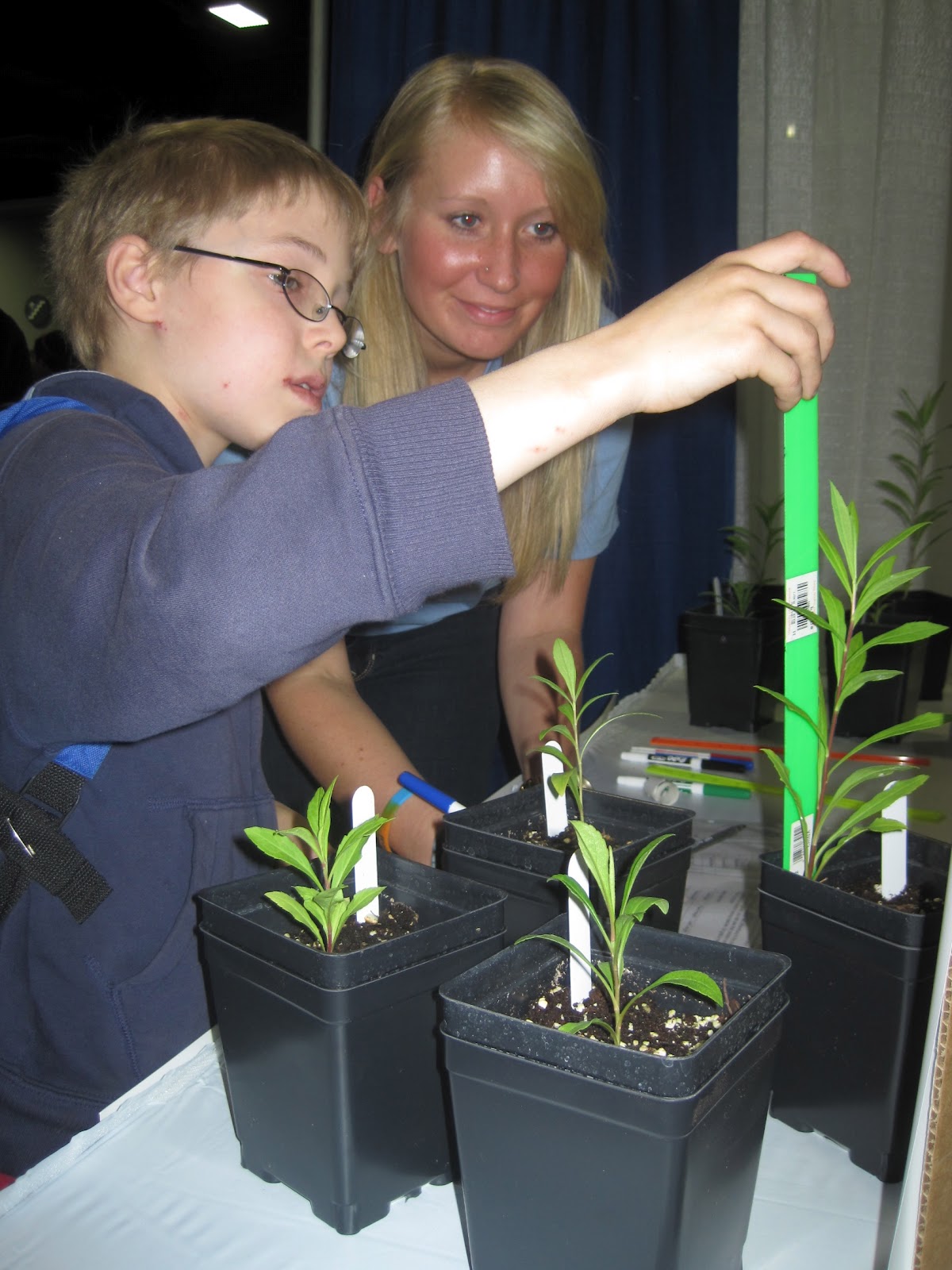
Sarah Wood, undergraduate in the Classen lab, teaches elementary students how to measure plant traits.


The USA Science and Engineering Festival on April 28 and 29 in Washington, DC brought the excitement of science to people from around the country. EEB and NIMBioS teamed up and presented two booths in the festival. Emily Austin and Jessica Bryant, Classen lab graduate students, taught Science Fest attendees about fungal decomposition of wood using decaying logs in terrariums. Sarah Wood, an undergraduate in the Classen Lab, and Kelly Sturner, education and outreach coordinator in NIMBioS, taught visitors about intra- and inter-specific variation in Solidago plants by having them measure stem and leaf traits. Both booths encouraged observations, data collection and graphical analysis. Many Science Fest attendees were families with elementary or middle school-aged children, but several teachers were there to pick up science project ideas for their classrooms. In all, an estimated 300,000 people left the event having learned at least one thing: science is exciting!

Filed Under: Classen, graduate, MAIN, NIMBioS, outreach, SciFest, undergraduate

EEB grad students and NIMBioS staff meet with Se. Corker staff

May 3, 2012 by wpeeb

(From left) Kelly Sturner (NIMBioS), Jessica Bryant (EEB), and Emily Austin (EEB) met with Hunter Bethea, a legislative assistant of Sen. Corker.

(From left) Kelly Sturner (NIMBioS), Jessica Bryant (EEB), and Emily Austin (EEB) met with Hunter Bethea, a legislative assistant of Sen. Corker.

Ecology & Evolutionary Biology (EEB) Department graduate students Emily Austin and Jessica Bryant along with Kelly Sturner, NIMBioS Education & Outreach Coordinator, were invited to visit the office of U.S. Sen. Bob Corker (R-TN) to talk about NIMBioS’ and EEB’s involvement in the USA Science & Engineering Festival. The group spoke with Hunter Bethea, legislative assistant to Corker, about how participation in federally-supported science education and outreach programs, such as NSF research experiences for undergraduates and Department of Energy education programs, led them to pursue science careers, and now inspire them to give back through participating in science outreach.

Filed Under: Classen, corker, graduate, MAIN, NIMBioS, outreach

  • « Previous Page
  • 1
  • …
  • 38
  • 39
  • 40
  • 41
  • 42
  • …
  • 48
  • Next Page »

Ecology & Evolutionary Biology

College of Arts and Sciences

569 Dabney Hall
Knoxville TN 37996-1610

Email: eeb@utk.edu

Phone: 865-974-3065

The University of Tennessee, Knoxville
Knoxville, Tennessee 37996
865-974-1000

The flagship campus of the University of Tennessee System and partner in the Tennessee Transfer Pathway.

ADA Privacy Safety Title IX