• Request Info
  • Visit
  • Apply
  • Give
  • Request Info
  • Visit
  • Apply
  • Give

Search

A-Z Index Map

Ecology & Evolutionary Biology

  • About
    • Give to EEB
    • Alumni
  • People
    • Faculty
    • Emeritus
    • Graduate Students
    • Adjunct
    • Postdocs
    • Research Staff
    • Administrative Staff
  • Undergraduate Students
    • EEB Concentration in Biology
    • EEB Minor
    • Honors
    • Course Descriptions
    • Naturalists Club
    • Fellowships
    • Be successful in EEB
  • Graduate Students
    • Graduate Student Handbook
    • FAQs
    • Applying to Grad School
    • GREBE
    • Funding
  • Research and Outreach
    • Research Highlights
    • Undergraduate Research Opportunities
    • Outreach Events
  • Collections and Facilities
    • UT Herbarium
    • UT Etnier Ichthyology Collection
    • Hesler Biology Greenhouses
    • Natural History Collections Course
    • Fellowships and Awards
    • Biology Field Station
  • News & Seminars
    • Current Seminars
    • News
    • Newsletter
Home » Archives for wpeeb » Page 43
Author: wpeeb

PNAS paper on dispersal and coexistence
September 20, 2011 by wpeeb


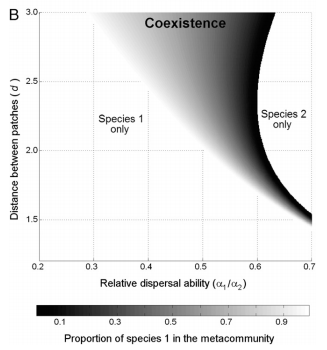
A recent paper in the Proceedings of the National Academy of Sciences by Michael Bode, Lance Bode, and UTK EEB assistant professor Paul Armsworth examines a novel mechanism that maintains diversity in patchy habitats. Abstract is below. See the full paper here. 


Abstract: The coexistence of multiple species on a smaller number of limiting resources is an enduring ecological paradox. The mechanisms that maintain such biodiversity are of great interest to ecology and of central importance to conservation. We describe and prove a unique and robust mechanism for coexistence: Species that differ only in their dispersal abilities can coexist, if habitat patches are distributed at irregular distances. This mechanism is straightforward and ecologically intuitive, but can nevertheless create complex coexistence patterns that are robust to substantial environmental stochasticity. The Great Barrier Reef (GBR) is noted for its diversity of reef fish species and its complex arrangement of reef habitat. We demonstrate that this mechanism can allow fish species with different pelagic larval durations to stably coexist in the GBR. Further, coexisting species on the GBR often dominate different subregions, defined primarily by cross-shelf position. Interspecific differences in dispersal ability generate similar coexistence patterns when dispersal is influenced by larval behavior and variable oceanographic conditions. Many marine and terrestrial ecosystems are characterized by patchy habitat distributions and contain coexisting species that have different dispersal abilities. This coexistence mechanism is therefore likely to have ecological relevance beyond reef fish.

Filed Under: Armsworth, conservation, ecology, MAIN, PNAS

Ecology Observatory in Oak Ridge

September 12, 2011 by wpeeb

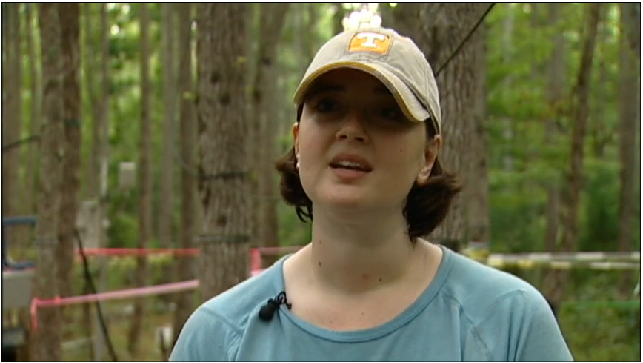
The Knoxville News-Sentinel newspaper recently covered the establishment of a UT/ORNL site as one of 20 ecological observatories funded as part of a new $434M national program. Members of EEB will be heavily involved in this research.

Filed Under: grant, MAIN, NEON, ORNL, Sanders

Paul Ehrlich addresses UT

August 26, 2011 by wpeeb

Famed ecologist Paul Ehrlich addressed an audience at UT as part of the Baker Center Interdisciplinary Group on Energy and Environmental Policy series.

Filed Under: Armsworth, Baker Center, ecology, MAIN, outreach

PNAS paper on complex codon usage patterns

August 19, 2011 by wpeeb

EEB grad student Premal Shah (now a postdoc in the Plotkin lab at the U. of Pennsylvania) and his adviser, Associate Prof. Mike Gilchrist, recently published a paper in the Proceedings of the National Academy of Sciences on “Explaining complex codon usage patterns with selection for translational efficiency, mutation bias, and genetic drift.”

Abstract: The genetic code is redundant with most amino acids using multiple codons. In many organisms, codon usage is biased toward particular codons. Understanding the adaptive and nonadaptive forces driving the evolution of codon usage bias (CUB) has been an area of intense focus and debate in the fields of molecular and evolutionary biology. However, their relative importance in shaping genomic patterns of CUB remains unsolved. Using a nested model of protein translation and population genetics, we show that observed gene level variation of CUB in Saccharomyces cerevisiae can be explained almost entirely by selection for efficient ribosomal usage, genetic drift, and biased mutation. The correlation between observed codon counts within individual genes and our model predictions is 0.96. Although a variety of factors shape patterns of CUB at the level of individual sites within genes, our results suggest that selection for efficient ribosome usage is a central force in shaping codon usage at the genomic scale. In addition, our model allows direct estimation of codon-specific mutation rates and elongation times and can be readily applied to any organism with high-throughput expression datasets. More generally, we have developed a natural framework for integrating models of molecular processes to population genetics models to quantitatively estimate parameters underlying fundamental biological processes, such a protein translation.

Filed Under: Gilchrist, graduate, MAIN, PNAS

Grant to Matheny for new Fungi of Australia volume

August 19, 2011 by wpeeb

Brandon Matheny and Neale Bougher (Department of Conservation, Western Australia) have received a grant from the Australian Biological Resources Study, in conjunction with matching funds from the Western Australia Naturalists’ Club, Inc., to add a systematic volume to the Fungi of Australia series. The subject of the volume will be the Inocybaceae of Australia, a family of ectomycorrhizal fungi particularly diverse in temperate regions of Australia.

Filed Under: Australia, grant, MAIN, Matheny

NEON construction to begin

July 29, 2011 by wpeeb

Funds have been released for the construction of the National Ecological Observatory Network (NEON) as of Aug. 2011.  From the release: “NEON plans to build 62 sites across the U.S., utilizing cutting-edge technology that will gather and synthesize continental-scale data over 30 years on the impacts of climate change, land use change and invasive species on natural resources and biodiversity. Such information will support the ability to understand and predict environmental change on regional and continental scales.”

There are two NEON sites near UTK: a core site at Walker Branch site at Oak Ridge, and a relocatable site in Great Smoky Mountains National Park. There are several other sites within a day’s drive of campus.

Filed Under: Great Smoky Mountains NP, MAIN, NEON, NSF, ORNL

ORNL summer research includes EEB alumni

July 28, 2011 by wpeeb

Two UTK EEB alumni are involved in work at Oak Ridge National Labs this summer on the effect of rising carbon dioxide levels on plant growth. Colleen Iversen was a graduate student in EEB and is now an ecoysystem ecologist at ORNL, while Lauren Breza was an EEB undergrad. Both worked in Aimee Classen‘s lab while at UT.

Filed Under: Classen, climate change, graduate, intern, MAIN, ORNL, undergraduate

PhD student Melissa Cregger receives DOE award

July 21, 2011 by wpeeb

Melissa Cregger, a PhD student in the Aimee Classen lab, was just awarded the 2011 Marvin L. Wesely Award from the Department of Energy. The award was established in honor of the late Dr. Marvin L. Wesely, Argonne National Laboratory senior meteorologist and chief scientist of the DOE Atmospheric Chemistry Program, who died Jan. 20, 2003 from heart cancer. The Marvin L. Wesely Fellowship is awarded to the Graduate Research Environmental Fellow (GREF) who has made the best use of their DOE mentor and facilities in improving the quality of his/her research efforts. The award is given for a one-year period to a current GREF fellow who has been supported to do global change research as part of the Global Change Education Program.

Filed Under: award, Classen, graduate, MAIN

Remembering Hal DeSelm

July 13, 2011 by wpeeb

Our esteemed colleague Hal DeSelm died July 12 at 7pm. Hal’s wife of 63 years, Bee, and their daughter Diane were with him.

The obituary and guestbook are here.

A memorial service is being held this Sunday, July 17 at 3pm at Tennessee Valley Unitarian and Universalist Church on Kingston Pike.

Condolences to Bee and their family.

Filed Under: DeSelm, Emeritus, faculty, MAIN

Bat grant to Jennifer Krauel

July 5, 2011 by wpeeb

Jennifer Krauel, a PhD student of Gary McCracken, recently got an award from Bat Conservation International for studying “Fall migration of Tadarida brasiliensis and their agricultural insect prey”.

Filed Under: bats, graduate, grant, MAIN, McCracken

  • « Previous Page
  • 1
  • …
  • 41
  • 42
  • 43
  • 44
  • 45
  • …
  • 48
  • Next Page »

Ecology & Evolutionary Biology

College of Arts and Sciences

569 Dabney Hall
Knoxville TN 37996-1610

Email: eeb@utk.edu

Phone: 865-974-3065

The University of Tennessee, Knoxville
Knoxville, Tennessee 37996
865-974-1000

The flagship campus of the University of Tennessee System and partner in the Tennessee Transfer Pathway.

ADA Privacy Safety Title IX