• Request Info
  • Visit
  • Apply
  • Give
  • Request Info
  • Visit
  • Apply
  • Give

Search

A-Z Index Map

Ecology & Evolutionary Biology

  • About
    • Give to EEB
    • Alumni
  • People
    • Faculty
    • Emeritus
    • Graduate Students
    • Adjunct
    • Postdocs
    • Research Staff
    • Administrative Staff
  • Undergraduate Students
    • EEB Concentration in Biology
    • EEB Minor
    • Honors
    • Course Descriptions
    • Naturalists Club
    • Fellowships
    • Be successful in EEB
  • Graduate Students
    • Graduate Student Handbook
    • FAQs
    • Applying to Grad School
    • GREBE
    • Funding
  • Research and Outreach
    • Research Highlights
    • Undergraduate Research Opportunities
    • Outreach Events
  • Collections and Facilities
    • UT Herbarium
    • UT Etnier Ichthyology Collection
    • Hesler Biology Greenhouses
    • Natural History Collections Course
    • Fellowships and Awards
    • Biology Field Station
  • News & Seminars
    • Current Seminars
    • News
    • Newsletter
Home » Featured » Page 6

Featured

Departmental Support Boosts NSF Awards For Graduate Students

April 26, 2024 by Logan Judy

Departmental Support Boosts NSF Awards For Graduate Students

by Randall Brown
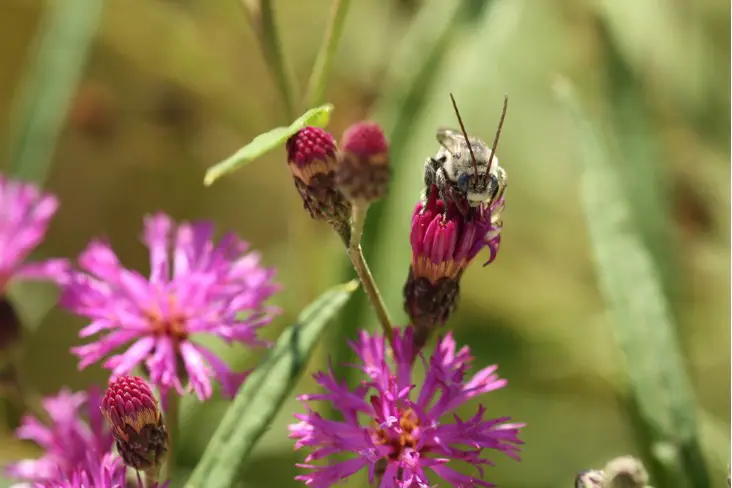
Sam Wilhelm’s winning proposal looked at how flowering plants and pollinating bees in the southeast respond and rebound to annual wildfires.

An increasing number of Vols in the Department of Ecology and Evolutionary Biology (EEB) earned awards through the National Science Foundation (NSF) Graduate Research Fellowship Program (GRFP). It marks a successful effort from the department to support researchers at the graduate level.

EEB winners are Sam Wilhelm, Kate Loveday, and Keelee Pullum. Other 2024 fellowship winners across the UT College of Arts and Sciences include Gage Coon from the Department of Microbiology and Charles Bell from the Department of Physics and Astronomy. 

“These are some of the most distinguished fellowships that a grad student can get,” said Stephanie Kivlin, associate professor and director of graduate studies in EEB. “It shows that our students are performing at a high level, really going above and beyond.”

The GRFP helps ensure the quality, vitality, and diversity of the US scientific and engineering workforce by supporting outstanding graduate students who are pursuing full-time, research-based graduate degrees in science, technology, engineering, and mathematics (STEM) or in STEM education.

The three new awardees this year make a total of six EEB students with GRFP fellowships, representing about 10% of the department’s current graduate students. Kivlin is excited that their student-support initiatives have garnered this high number of fellowships. 

“It’s nice to see the professional development training that we’re doing in the department is really paying off for our students,” she said. “We started a mock panel to review proposals before they are submitted in 2019. Since then, we’ve had so many more proposals funded. We also have writing and presentation classes, so our students are trained in multiple skills for the workforce.”

The GRFP provides three years of support over a five-year fellowship period for the graduate education of students who have demonstrated their potential for significant research achievements.

“If you have your own funding as a graduate student, you can pursue whatever question you want,” said Kivlin. “Often those are independent of the principal investigators of the graduate labs. It springboards students’ careers then because everyone can see that they have already started doing independent research.”

Wilhelm’s winning proposal looked at how flowering plant communities in the southeast respond and rebound to annual wildfires, and how that in turn might mediate the associated bee community in the area.

“I used metacommunity theory to hypothesize that different fire regimes may support a mosaic of different plant-bee ‘interaction metacommunities’ at the landscape scale,” said Wilhelm. “I proposed to test this by comparing plant-bee interaction dynamics across multiple annual fire treatments that differ in seasonality. I am thrilled to receive this award that will allow me to continue studying native bees and conservation of the ecosystems that sustain them.”

Loveday’s proposal looked into the mechanisms that allow invasive plant species to outcompete native herbaceous understories of forests.

“The GRFP is great because the NSF funds the potential of the applicant to do research effectively, not the specific projects you write up, which reinforces my confidence in doing research,” said Loveday. “The grant gives me the opportunity to pursue research questions I am passionate to answer.”

Pullum’s project aims to test how sickness behavior and parental care are traded off in the wild and how both parent and offspring fitness are affected.

“I plan to carry out these experiments for snow buntings, a species of arctic-breeding songbirds that migrate yearly to Utkiagvik, Alaska,” said Pullum. “The funding from the NSF GRFP will allow me to focus on research and community outreach during my graduate studies.”

EEB students Dusty Prater and Trina Chou earned honorable mentions for their proposals.

In microbiology, Gage Coon’s successful GRFP project aims to develop a microbial cycle that would turn atmospheric CO2 into calcium carbonate (rocks). Charles Bell, GRFP winner in physics, proposed novel ways to detect and investigate dark matter.
Filed Under: Featured, MAIN

Faculty Recognized for Excellence in Teaching, Service, and Academic Outreach

March 27, 2024 by Logan Judy

Faculty Recognized for Excellence in Teaching, Service, and Academic Outreach

During the 2023 UT College of Arts and Sciences faculty convocation, EEB faculty received awards for excellence in teaching, research, and academic outreach. 

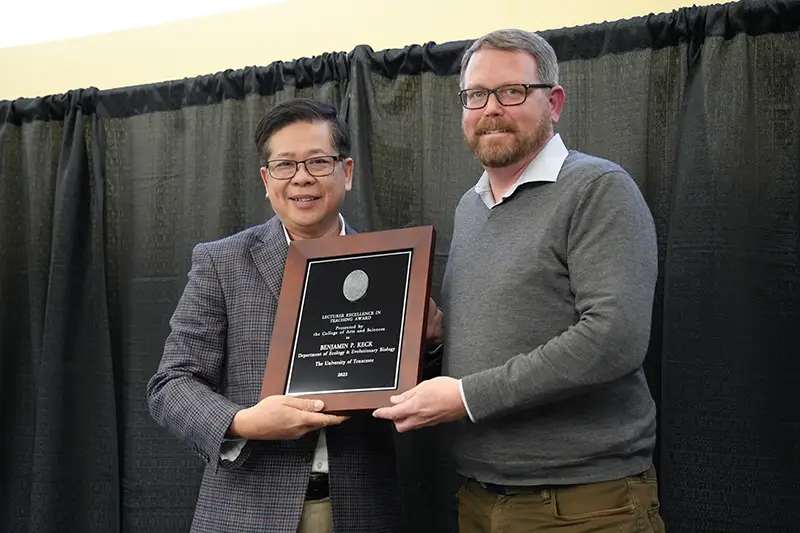
Benjamin Keck, Lecturer – Excellence in Teaching Awards: Lecturer

Benjamin Keck is presented with an award by Liem Tran at the Faculty Awards Ceremony

Ben Keck is an outstanding and dedicated lecturer for the University of Tennessee who has supported student learning in the classroom, in the field, and in the lab for many years. His teaching practice stands out for his high level of innovation, enthusiasm, and positive course climate.

Keck is a dedicated undergraduate teacher of both introductory biology courses and upper-level majors courses. His appointment is across two units—general biology and EEB—and he makes a huge contribution both as a teacher and a mentor to students. As the Director of the Ichthyology Collection at UT, Keck also makes outstanding contributions to community outreach efforts to highlight the diversity and importance of fishes in Eastern Tennessee.


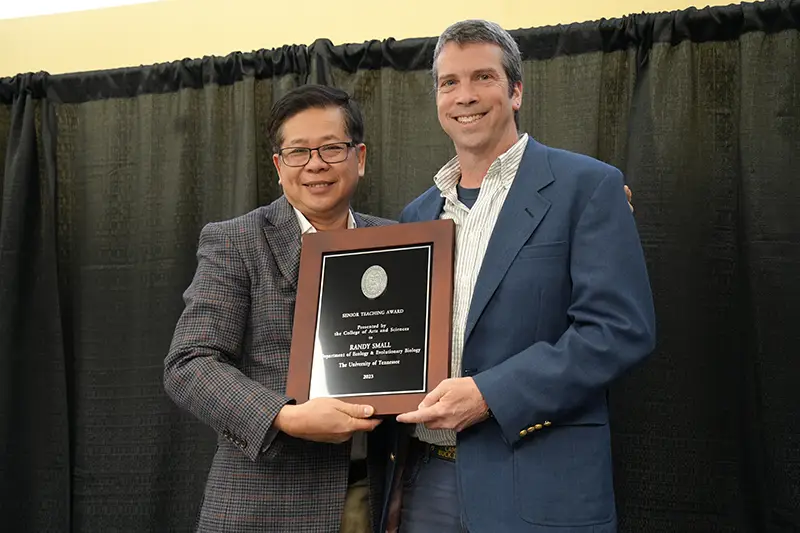
Randy Small, Professor – Excellence in Teaching Awards: Senior

Randy Small is presented with an award by Liem Tran at the Faculty Awards Banquet

Randy Small is a full professor in EEB and has been the director for Teaching and Learning in the Division of Biology since 2019. His first rate and long-standing contributions to the educational mission of the College of Arts and Sciences makes him the perfect winner of this award. Legions of students in EEB as a department and the whole Division of Biology have benefited from Small’s dedication to student success, outstanding teaching practice, and educational vision and leadership. This award is long overdue.


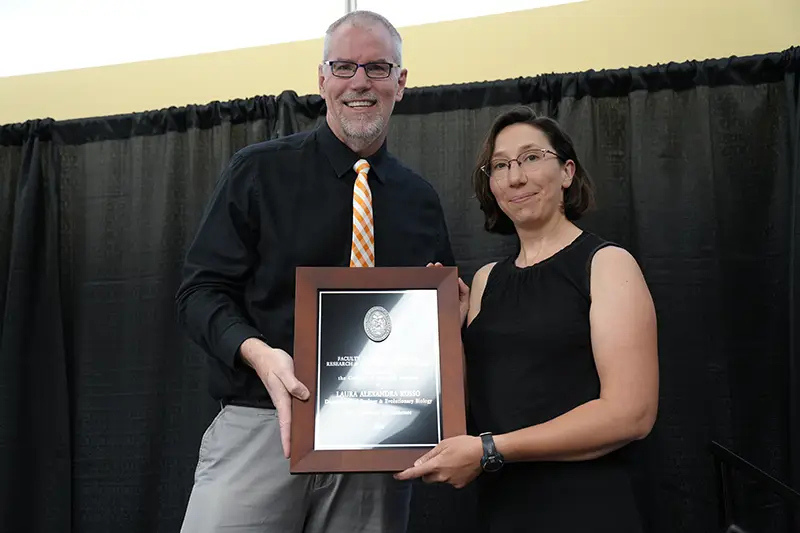
Laura Alexandra Russo, Assistant Professor – Faculty Academic Outreach Award: Research & Creative Activity

Laura Alexandra Russo is presented with an award at the Faculty Awards Ceremony

Russo is an outstanding faculty member in the Department of Ecology and Evolutionary Biology whose outreach has raised the profile of UT Knoxville scientifically and to the public. Her research engages the public, community groups, state agencies, students, and others to tackle declines in bee species and other pollinators and what can be done to reverse these trends. Her approach exemplifies engaged scholarship that is conducted with and in communities.

Russo regularly leads outreach events at state parks like Seven Islands and Roan Mountain and national parks like the Great Smoky Mountains, including pollinator and plant hikes and bioblitzes in which community members find, identify, and document biodiversity. She actively engages with UT Extension, giving seminars and running outreach events at UT’s research and education centers across the state.


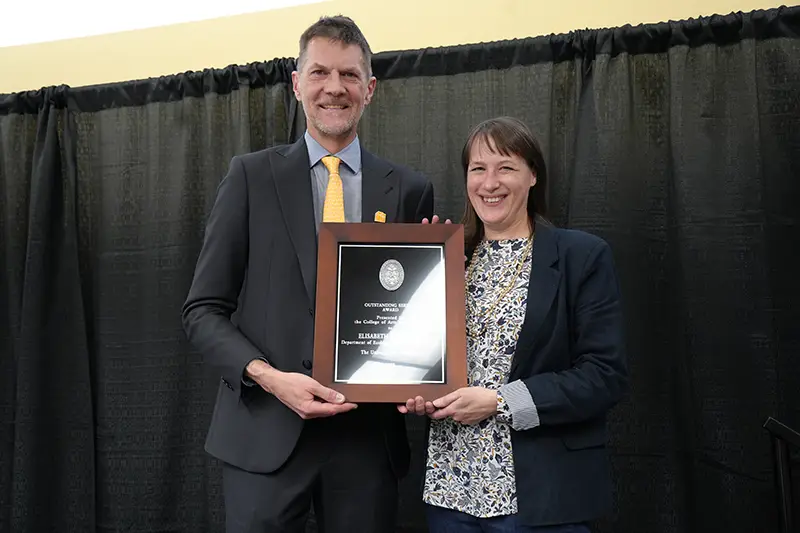
Elisabeth Schussler, Professor – Outstanding Service Award

Elisabeth Schussler is presented an award by Robert Hinde at the Faculty Awards Ceremony

In her role as Director of Biology Teaching and Learning, Professor Schussler ensures our students in the lower-division biology courses receive excellence instruction from our graduate teaching assistants and nontenure-track faculty. 

She provides professional development opportunities for instructors to be at the top of their teaching game and it is this passion for high-quality teaching across the natural sciences that led her to build teams of faculty members across the college and university who also want high-quality instruction in lower-level courses. As Faculty Senate president, she supported the ideas of liberal arts learning through cultivation of a strong shared governance process. 

Filed Under: faculty, Faculty, Featured

Kimberly Sheldon’s Research Featured on CBS

February 28, 2024 by Logan Judy

Kimberly Sheldon’s research on climate change effects on dung beetles was featured on CBS Saturday Morning, as part of a segment on insect declines in the Anthropocene.

Filed Under: faculty, Faculty, Featured, MAIN, Sheldon

Graduate Student Wieteke Holthuijzen Published in ‘The Conversation’

February 23, 2024 by Logan Judy

Murderous mice attack and kill nesting albatrosses on Midway Atoll − scientists struggle to stop this gruesome new behavior

Their ‘island naïveté’ means these seabirds are easy pickings when mice attack. USFWS – Pacific Region/Flickr, CC BY-NC
Wieteke Holthuijzen, University of Tennessee

At the far end of the Northwestern Hawaiian Islands lies Kuaihelani – also known as Midway Atoll – a small set of islands home to the world’s largest albatross colony. Over a million albatrosses return to Kuaihelani each year to breed. These seemingly pristine islands appear safe, but there’s a predator lurking among the seabirds.

House mice (Mus musculus) — the same kind that may be in your residence — have started to attack and kill albatrosses, eating them alive as they sit on their nests. I’m an ecologist who’s been studying the mystery behind these murderous mice.

A predator hiding in plain sight

Once the site of intense warfare during World War II, Kuaihelani is now a national wildlife refuge.

Without predators such as cats, rats or mongooses, Kuaihelani provides a safe haven for millions of nesting and migratory birds, including mōlī (Phoebastria immutabilis), also known as Laysan albatrosses. These seabirds, each about the size of a goose, nest in nearly the exact same spot each year, producing only one egg annually.

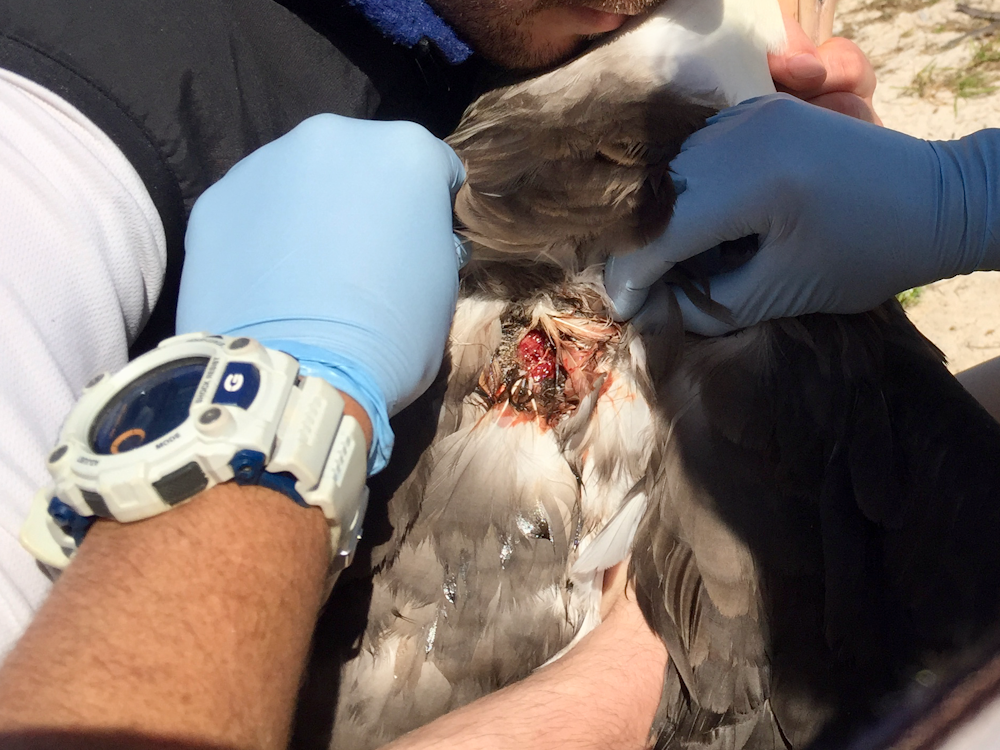
One person holds a large bird while another, wearing medical gloves, inspects a bloody wound on its back.
Biologists examine wounds on an adult mōlī caused by invasive house mice. USFWS – Pacific Region/Flickr, CC BY-NC

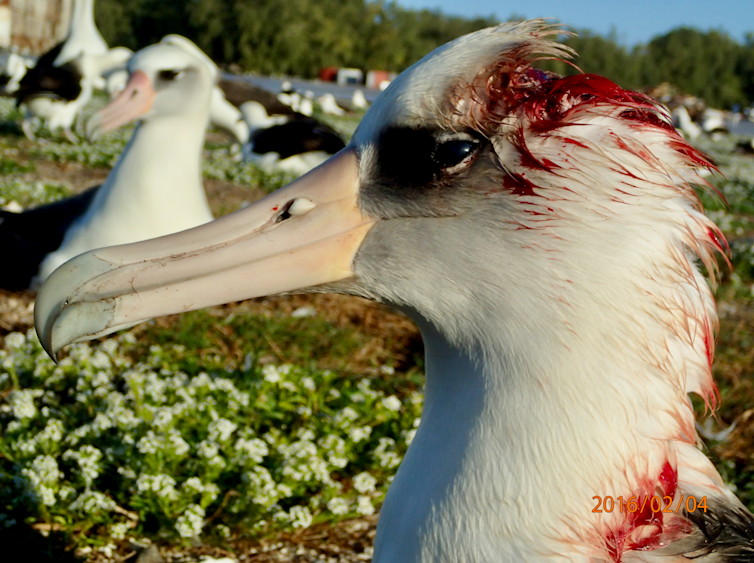
In the winter nesting season of 2015, bird-counting volunteers and biologists began seeing gruesome bloody wounds on nesting mōlī. At first, they found only a few mōlī with these mysterious injuries, which included severe chewing along the neck and even scalping. In the weeks that followed, they found dozens of injured mōlī, then hundreds.

Biologists were stumped. Had a black rat escaped off a docked boat? Had a peregrine falcon blown in with the latest winter storm? Desperate to identify the culprit, biologists set up game cameras around nesting mōlī.

Time-lapse night vision footage shows a mouse attacking the head and body of a nesting mōlī.

The cameras captured bizarre nighttime footage of mice crawling and chewing on the backs and heads of mōlī. It was the first time a house mouse had ever been observed attacking a live adult, nesting albatross.

Mōlī, like many seabirds, have evolved without predators on remote islands. As a result, such seabirds are often oddly unafraid and curious – pulling on researchers’ shoelaces or nibbling at our clipboards. This phenomenon is called “island naïveté” and, however charming, can spell disaster when nonnative predators such as rats and cats are introduced to islands. Lacking innate caution, even the largest seabirds can become the defenseless prey of predators as small as a mouse.

A black and white aerial photo of two small island. The one in the foreground has three intersecting landing strips.
The World War II military base on Midway Atoll including an airfield on Eastern Island and more facilities on Sand Island, across the channel. U.S. Navy/Wikimedia Commons

Developing a taste for flesh

During World War II, the islands of Kuaihelani were cleared and covered with wartime infrastructure. Both black rats and house mice were inadvertently introduced at this time. Soon, the rats began decimating populations of burrowing seabirds.

When the military importance of Kuaihelani faded in the 1990s, management of the atoll was transferred to the U.S. Fish and Wildlife Service. Rats were successfully eradicated in 1996, but mice remained. Thought to be small and harmless, they didn’t generate much concern until 2015.

Although scientists may never know exactly why mice began to attack and kill mōlī, we have some ideas.

Due to climate change, Kuaihelani has experienced increasingly erratic precipitation, sometimes resulting in long dry spells or intense downpours. During dry periods, vegetation quickly dies back. It’s likely the usual food items for mice, namely seeds and bugs, decline during these periods. In order to survive, mice need to find a different food source.

On an island with millions of birds, seabird carcasses are plentiful and attract a rich community of bugs, including cockroaches, isopods and maggots. Mice appear to have quite an appetite for these critters and likely feed on seabird carcasses at the same time. The transition from scavenging dead seabirds to attacking live ones that don’t fight back is only a small step.

As mouse attacks on nesting mōlī escalated from 2015 on, it was clear something needed to be done – and fast. The solution was to get rid of the mice, which, unfortunately, is much easier said than done.

Die-hard mice

Mouse eradication is a challenging and risky conservation endeavor that requires years of research and careful planning. Ideally, rodenticide, a type of poison used to kill rodents, should be offered when mice are most hungry and likely to eat it. This requires knowing exactly what they are eating and when those food sources are scarce.

By extracting and sequencing DNA from mouse poop and analyzing stable isotopes – a technique that identifies unique chemical fingerprints of organisms – my colleagues and I could figure out what organisms mice were eating and in what quantities. We found that mice on Sand Island of Kuaihelani mainly eat bugs (about 62% of their diet), followed by plants (27%) and finally albatross (likely mōlī, about 12%). The Fish and Wildlife Service identified July as the best time for the eradication attempt, since seabird density is typically lowest then.

Because of COVID-19 disruptions, the eradication attempt was delayed until July 2023, when the nonprofit organization Island Conservation and the Fish and Wildlife Service meticulously applied rodenticide in multiple rounds. At first, it seemed to be working. But in the weeks that followed, a few mice were spotted – then more. By September 2023, the eradication was declared unsuccessful.

Some conservation practitioners believe eradication should be attempted again, but others worry about creating mice resistant to rodenticide. When generations of rodents are exposed to rodenticide repeatedly, they may start to carry genetic mutations resulting in resistance to the poison, making future eradication efforts ineffective.

Without a doubt, mice on Kuaihelani have already been exposed to rodenticide for a long time. When Kuaihelani – or Midway Atoll – was a naval base, rodenticide was likely applied in and around buildings and residences. The rat eradication in 1996 was another exposure. I’m currently researching whether the mice on Kuaihelani already have these genetic mutations.

The worries about rodenticide-resistant mice aren’t limited to Kuaihelani. Around the world, especially in Europe, there are more and more cases of rodents carrying resistance. Rodents continue to have severe and widespread ecological effects on islands worldwide.

For now, I’m focused on helping the mōlī of Kuaihelani survive. But our research may also help inform the growing challenge of resistant mice around the world.The Conversation

Wieteke Holthuijzen, Ph.D. Candidate in Ecology and Evolutionary Biology, University of Tennessee

This article is republished from The Conversation under a Creative Commons license. Read the original article.

Filed Under: climate change, ecology, Featured, Graduate Students, invasive, MAIN, NSF

  • « Previous Page
  • 1
  • …
  • 4
  • 5
  • 6

Recent Posts

  • EEB’s UT Fungal Collection Dedicated in Honor of Two UT Emeritus Professors
  • The Evolutionary Case for a Little Roughhousing
  • EEB Says Goodbye to Sandy Echternacht
  • Scholar Spotlight: Chuck Price
  • Fern Scientist Uncovers How Limits Fuel Evolution

Recent Comments

No comments to show.

College of Arts & Sciences

117 Natalie L. Haslam Music Center
1741 Volunteer Blvd.
Knoxville TN 37996-2600

Phone: 865-974-3241

Archives

  • January 2026
  • December 2025
  • November 2025
  • October 2025
  • September 2025
  • August 2025
  • July 2025
  • April 2025
  • March 2025
  • February 2025
  • January 2025
  • November 2024
  • October 2024
  • August 2024
  • July 2024
  • June 2024
  • May 2024
  • April 2024
  • March 2024
  • February 2024
  • December 2023
  • November 2023
  • October 2023
  • September 2023
  • August 2023
  • July 2023
  • June 2023
  • May 2023
  • April 2023
  • March 2023
  • February 2023
  • January 2023
  • December 2022
  • November 2022
  • August 2022
  • June 2022
  • April 2022
  • March 2022
  • October 2021
  • August 2021
  • June 2021
  • April 2021
  • February 2021
  • January 2021
  • December 2020
  • November 2020
  • September 2020
  • August 2020
  • June 2020
  • May 2020
  • March 2020
  • February 2020
  • January 2020
  • December 2019
  • November 2019
  • October 2019
  • September 2019
  • August 2019
  • April 2019
  • March 2019
  • November 2018
  • June 2018
  • May 2018
  • April 2018
  • March 2018
  • February 2018
  • January 2018
  • December 2017
  • November 2017
  • October 2017
  • September 2017
  • August 2017
  • July 2017
  • June 2017
  • May 2017
  • April 2017
  • March 2017
  • February 2017
  • January 2017
  • December 2016
  • November 2016
  • October 2016
  • September 2016
  • August 2016
  • July 2016
  • June 2016
  • May 2016
  • April 2016
  • March 2016
  • February 2016
  • January 2016
  • December 2015
  • November 2015
  • October 2015
  • September 2015
  • August 2015
  • July 2015
  • June 2015
  • April 2015
  • March 2015
  • February 2015
  • January 2015
  • November 2014
  • October 2014
  • September 2014
  • August 2014
  • July 2014
  • June 2014
  • May 2014
  • April 2014
  • March 2014
  • February 2014
  • January 2014
  • December 2013
  • November 2013
  • October 2013
  • September 2013
  • August 2013
  • July 2013
  • June 2013
  • May 2013
  • April 2013
  • March 2013
  • January 2013
  • December 2012
  • October 2012
  • September 2012
  • August 2012
  • June 2012
  • May 2012
  • April 2012
  • March 2012
  • February 2012
  • January 2012
  • December 2011
  • October 2011
  • September 2011
  • August 2011
  • July 2011
  • June 2011
  • May 2011
  • April 2011
  • March 2011
  • February 2011
  • January 2011
  • November 2010

Categories

  • Adjunct
  • alumni
  • ants
  • Armsworth
  • Auerbach
  • Australia
  • award
  • Bagby
  • Bailey
  • Baker Center
  • Banbury
  • bats
  • behavior
  • Blum
  • Boake
  • book
  • Boyer
  • Budke
  • Burghardt
  • citizen science
  • Classen
  • climate change
  • conservation
  • corker
  • course
  • damage
  • Darwin Day
  • DDIG
  • Derryberry
  • DeSelm
  • DOE
  • Echternacht
  • ecology
  • education
  • Emeritus
  • endowment
  • EOL
  • EUReCA
  • events
  • extinction
  • facilities
  • faculty
  • Faculty
  • Featured
  • Fefferman
  • fellowship
  • field course
  • fish
  • Fitzpatrick
  • Fordyce
  • Former Faculty
  • Former Graduate Students
  • fundraiser
  • fungi
  • Gaoue
  • Gavrilets
  • Giam
  • Gilchrist
  • graduate
  • Graduate Students
  • graduation
  • grant
  • Great Smoky Mountains NP
  • GREBE
  • greenhouse
  • Gross
  • Hallam
  • head
  • Hemingway
  • herbarium
  • Hughes
  • Hulsey
  • human evolution
  • intern
  • invasive
  • jobs
  • Kalisz
  • Kivlin
  • Kwit
  • MAIN
  • math
  • Matheny
  • McCracken
  • media
  • modeling
  • National Academy of Sciences
  • Nature
  • NCEAS
  • NEON
  • News Sentinel
  • newsletter
  • newspaper
  • NIMBioS
  • NSF
  • Nyari
  • O'Meara
  • obituary
  • ORNL
  • outreach
  • Papes
  • Petersen
  • placement
  • plos one
  • PNAS
  • podcast
  • popular media
  • postdoc
  • publication
  • Research Staff
  • REU
  • Riechert
  • Rstats
  • Russo
  • Sanders
  • Schilling
  • Schussler
  • Schweitzer
  • Science
  • SciFest
  • seminar
  • Sheldon
  • Simberloff
  • slate
  • Small
  • staff
  • STEM
  • Stockmaier
  • Suissa
  • summer
  • Tanner
  • taxonomy
  • teaching
  • TennesseeToday
  • Uncategorized
  • Undergrad News
  • undergraduate
  • wildflower pilgrimage
  • Williams
  • WNS
  • Wofford

Copyright © 2026 · University of Tennessee, Knoxville WDS Genesis Child on Genesis Framework · WordPress · Log in

Ecology & Evolutionary Biology

College of Arts and Sciences

569 Dabney Hall
Knoxville TN 37996-1610

Email: eeb@utk.edu

Phone: 865-974-3065

The University of Tennessee, Knoxville
Knoxville, Tennessee 37996
865-974-1000

The flagship campus of the University of Tennessee System and partner in the Tennessee Transfer Pathway.

ADA Privacy Safety Title IX