When you look out across a snowy winter landscape, it might seem like nature is fast asleep. Yet, under the surface, tiny organisms are hard at work, consuming the previous year’s dead plant material and other organic matter.
These soil microorganisms – Earth’s recyclers – liberate nutrients that will act as fertilizer once grasses and other plants wake up with the spring snowmelt.
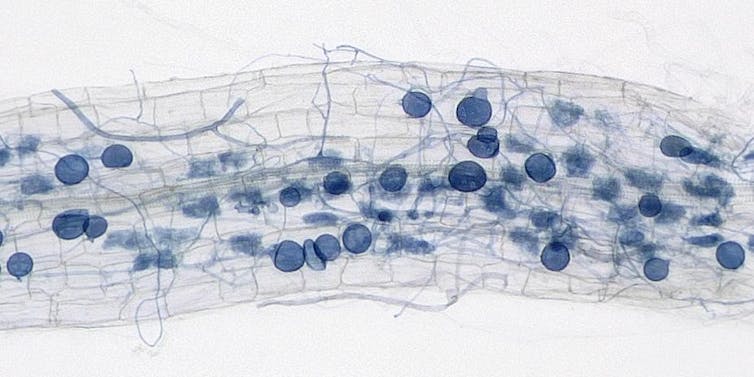
Key among them are arbuscular mycorrhizal fungi, found in over 75% of plant species around the planet. These threadlike fungi grow like webs inside plant roots, where they provide up to 50% of the plant’s nutrient and water supply in exchange for plant carbon, which the fungi use to grow and reproduce.
A magnified view shows filaments and vesicles of arbuscular mycorrhizal fungi weaving through the outer cells of a plant root. Outside the root, the filaments of hyphae gather nutrients from the soil.Edouard Evangelisti, et al., New Phytologist, 2021, CC BY
In winter, the snowpack insulates mycorrhizal fungi and other microorganisms like a blanket, allowing them to continue to decompose soil organic matter, even when air temperatures above the snow are well below freezing. However, when rain washes out the snowpack or a healthy snowpack doesn’t form, water in the soil can later freeze – as can mycorrhizal fungi.
In a new study in the Rocky Mountain grasslands, we dug into plots of land that for three decades scientists led by ecologist John Harte had warmed by 2 degrees Celsius (3.6 Fahrenheit) using suspended heaters that mimicked the air temperature the area is likely to see by the end of this century.
Above ground, the plots shifted over that time from predominantly grassland to more desertlike shrublands. Under the surface, we found something else: There were noticeably fewer beneficial mycorrhizal fungi, which left plants less able to acquire nutrients or buffer themselves from environmental stressors like freezing temperatures and drought.
These changes represent a major shift in the ecosystem, one that, on a wide scale, could reverberate through the food web as the grasses and forbs, such as wildflowers, that cattle and wildlife rely on decline and are replaced by a more desertlike environment.
When plants and fungi get out of sync
Warmer winters and a changing snowpack can affect the growth of plants and fungi in a few important ways.
One of the first signs of changing winters is when the timing of plant, fungal and animal activities that rely on one another get out of sync. For example, a mountain of evidence from around the world has documented how early snowmelt can lead to flowers blooming before pollinators arrive.
Timing also matters for plants that rely on mycorrhizal fungi – their growth must overlap.
Since plants are cued to light in addition to temperature, whereas underground microorganisms are cued to temperature and nutrient availability, warmer winters may cause microorganisms to be active well before their plant counterparts.
A view across the subalpine grasslands outside the experimental plots.Stephanie Kivlin
At our research site, in a subalpine meadow in Colorado, we also initiated an early snowmelt experiment in April 2023 that advanced snowmelt in five large plots by about two weeks.
We found that the early snowmelt advanced mycorrhizal fungal growth by one week, but we didn’t find a corresponding change in the growth of plant roots. When mycorrhizal fungi are active before plants, the plants don’t benefit from the nutrients that mycorrhizal fungi are taking up from the soil.
Disappearing nutrients
Early snowmelt can also lead to a loss of nutrients from the soil.
When microorganisms decompose organic matter in warmer soils, nutrients accumulate in the air and water pockets between soil particles. These nutrients are then available for mycorrhizal fungi to transfer to plants. While mycorrhizal fungi transfer nutrients to the plant, other fungi are primarily decomposers that keep the nutrients for themselves.
However, if rain falls on the snow or the snow melts early, before plants are active, the nutrients can leach from the soil into lakes and streams. The effect is similar to fertilizer runoff from farm fields – the nutrients fuel algae growth, which can create low-oxygen dead zones. At the same time, plants in the field have fewer nutrients available.
Without a thick snowpack, soils can also freeze for longer periods in the winter, leading to lower microbial activity and scarce resources at the onset of spring.
The future of changing winters
Under all of these scenarios – a timing mismatch, more rain causing nutrients to leach out or frozen soil – warmer winters are leading to less spring growth.
Ecosystems are often resilient, however. Organisms could acclimate to lower nutrient concentrations or shift their ranges to more favorable conditions. How plants and mycorrhizal fungi both adapt will determine how this hidden world adjusts to changing winters.
So, the next time rain on snow or a snow drought delays your outdoor winter plans, remember that it’s more than a hassle for humans – it’s affecting that hidden world below, with potentially long-term effects.
Two researchers at the University of Tennessee, Knoxville, have received prestigious National Science Foundation CAREER awards to help them establish a firm foundation for a lifetime of leadership in integrating education and research.
Stephanie Kivlin, an associate professor in the Department of Ecology and Evolutionary Biology, and Wei Wang, an assistant professor in the Department of Mechanical, Aerospace, and Biomedical Engineering, join the NSF’s Faculty Early Career Development (CAREER) Program, which supports the nation’s best early-career faculty and recognizes their promise as academic role models in research and education.
EEB’s Dr. Stephanie Kivlin joins her collaborators in announcing the release of their new report, “Microbes in Models.” Climate change threatens all life on Earth. The report outlines top challenges to overcome to better incorporate microbial processes into Earth system models and improve model projections that inform climate change mitigation actions. Read more here: https://eeb.utk.edu/wp-content/uploads/2023/06/Microbes-in-Models-Report_FINAL.pdf
Stephanie Kivlin, assistant professor in the UT Department of Ecology and Evolutionary Biology (EEB), and co-principal investigators, Susan Kalisz and Nick Smith, received a $3.58 million National Science Foundation (NSF) grant to fund collaborative research for their project “Defining the mechanisms and consequences of mutualism reorganization in the Anthropocene.”
Kivlin and her colleague Kalisz, EEB professor, received $2.33 million of the grant, while Smith, assistant professor in Department of Biological Sciences at Texas Tech University, received the remaining funding.
The five-year study will allow Kivlin and her colleagues to research the symbiotic relationships between plants and fungi and how global changes, including invasive species, affect them.
“Our current collaborative NSF integrative biology grant will investigate how invasive plants disrupt native plant and mycorrhizal fungal associations from small-scale nutrient fluxes to native plant health, composition, and ecosystem carbon and nutrient cycles,” Kivlin said.
The project builds off decades of Kalisz’s NSF-funded long-term research in environmental biology studies at the Trillium Trail in Pittsburgh that focused on the effects of the presence of garlic mustard, a highly invasive plant species, on native plant species.
“Plant invasions are one of the largest impacts of human land-use across Earth, but the effects of invasions on belowground processes have largely been unexplored. Our project will unearth these hidden effects so society can be better prepared to mitigate detrimental effects on native plants in the future,” Kivlin said.
There is not currently enough information about how interactions between plants and fungi respond to climate and land-use change because these interactions tend to be hidden and widely dispersed.
“Fundamental knowledge from our work will determine how global change will disrupt interactions among organisms in natural ecosystems. Many plants and animals, like humans, rely on their microbiome to survive and thus, it is crucial that we understand how these interactions will perform under future conditions,” Kivlin said.
Undergraduate students in underrepresented groups from rural Appalachia who otherwise would not have the opportunity to engage in research will be given the chance to do so. Students will conduct laboratory experiments at UT and will partake in field experiments in Pittsburgh.
Stephanie Kivlin, an assistant professor of ecology and evolutionary biology, coauthored a paper titled “Fungal aerobiota are not affected by time nor environment over a 13-y time series at the Mauna Loa Observatory,” published in the journal Proceedings of the National Academy of Sciences.
Researchers used 13 years of collected air samples from Mauna Loa Observatory on Hawaii Island to determine if local or global environmental factors influence fungi composition.
“One of the big questions in microbial ecology is trying to figure out how microbes disperse around the world and if they can disperse everywhere,” Kivlin said.
Kivlin and other researchers from the University of Hawaii initially genetically sequenced fungal spores and studied their traits, such as size and shape, before discovering the role wind patterns play in fungal spore dispersal.
“What we found was that we could trace back wind patterns to try to understand where the wind was coming from that deposited the fungal spores on the filters,” Kivlin said. “We saw some that were coming from Asia, bringing fungi that are never found in Hawaii. The wind patterns are really what’s blowing the fungi around.”
The researchers also discovered that some airborne fungal spores are still viable after traveling long distances.
“Because we found a couple of fungi that were dispersing all the way across the Pacific Ocean, we need to really consider how far fungi can go and what that means for dispersal of new pathogens into new areas,” Kivlin said. “We need to have better theory about how often those dispersal events occur, which fungi are coming, and if they are beneficial or harmful.”
Coauthors on the paper include Laura Tipton, Anthony Amend, and Nicole Hyson from the University of Hawaii at Manoa, Erin Datlof from the University of Hawaii at Hilo, Geoffrey Zahn from Utah Valley University, and Patrick Sheridan from the National Oceanic and Atmospheric Administration’s Global Monitoring Division.
For a plant to thrive, it needs the help of a friendly
fungus–preferably one that will dig its way deep into the cells of the plant’s
roots.
Plants live in symbiosis with root-associated, or
mycorrhizal, fungi. The fungi provide up to 80 percent of the nutrients and
water a plant needs to grow, and the plants produce up to 30 percent of the
photosynthate–a food substance made through photosynthesis–that the fungi
need.
There are two main types of mycorrhizal fungi – arbuscular
and ectomycorrhizal. An arbuscular mycorrhiza penetrates the cortical cells of
the roots of a plant. Ectomycorrhizal fungi do not penetrate the plant’s cell
walls, instead forming a netlike structure around the plant root.
A new paper published in the Proceedings of the National Academy of Sciences and co-authored by
ecologist Stephanie Kivlin, an assistant professor at the University of
Tennessee, Knoxville, shows that arbuscular mycorrhizal fungi are especially
helpful to the plants they colonize.
“Mycorrhizal fungal associations below the ground
are one of the largest influences on plant tissue nutrient
concentrations,” said Kivlin. “To optimize plant nutrition, we need
to incorporate mycorrhizal associations into our agricultural and management
frameworks.”
Arbuscular mycorrhizal fungi increase plant nutrient
concentrations in plant leaves, litter, and roots more than ectomycorrhizal
fungi. The type of root-associated fungi present has more influence on a
plant’s nutrient levels than plant leaf traits or plant associations with
nitrogen-fixing bacteria.
Kivlin’s co-authors are Colin Averill from ETH Zürich,
Jennifer M. Bhatnagar and Michael C. Dietze from Boston University, and William
D. Pearse from Utah State University.
The study analyzed more than 17,000 trait observations
from nearly 3,000 woody plant species in six categories that demonstrate how
readily the plant uses nutrients: the nitrogen and phosphorous concentrations
in green leaves, senescent leaves–leaves that are about to fall off or have
recently fallen off–and roots. It looks at how mycorrhizal effects vary across
environments, doing similar analyses in boreal, temperate, and tropical
latitudinal zones.
The Kivlin Lab studies the effects of global change on the distributions, function, and ecosystem consequences of plant mycorrhizal fungal associations worldwide.
“The next steps are to understand if there is variation in nutrient acquisition among fungal species within each mycorrhizal group and how soil nutrient concentrations may interact to influence plant nutrient concentrations with global change,” Kivlin said.
Plants interact with many biotic entities – from other plants and microorganisms to animals – but little is known about the relative influence each of these interactions has on determining plant growth and survival. Most plants compete with each other for resources, such as space and light. Plants also interact with microbial mutualists, which can be beneficial for the plants because these microorganisms acquire nutrients the plant needs to grow and thrive. The interplay of all these interactions determines the success and growth of an individual plant.
“The relative importance of competition versus plant soil feedback on plant performance is poorly understood,” says Stephanie Kivlin, co-author and assistant professor in the Department of Ecology and Evolutionary Biology.
Kivlin and her colleagues quantified the relative importance of plant-plant and plant-microbial interactions on plant growth across 150 difference plant species. They discovered that competitive plant-plant interactions were the main driver of plant growth, but negative plant-microbial interactions were also prevalent.
“What we discovered suggests microbes limit plant growth of the strongest competitor in a variety of natural ecosystems,” Kivlin says.
Microbes and fungi can have a significant impact on plant diversity. Without them, plants that compete best for light, water, and nutrients would dominate environments such as grasslands and forests. This study suggests microorganisms play a key role in maintaining biodiversity of plant species in natural environments.
Since this is the first work to document the relative importance of plant-plant and plant-microbial interactions, it will most likely shape the theory about when and where each of these interactions structures plant community diversity and composition.
“Our department is a hub of biodiversity and conservation research,” Kivlin says. “As we move forward as a center for biodiversity research in one of the most biodiverse areas on the planet, this work will be key in reminding us to consider the invisible microbial actors that silently structure many of the plant communities in this region and across the globe.”
The authors would like to acknowledge MPG Ranch for generously supporting the plant-soil feedback workshop that generated the ideas for this publication.




 Stephanie Kivlin, assistant professor in the UT Department of Ecology and Evolutionary Biology (EEB), and co-principal investigators, Susan Kalisz and Nick Smith, received a $3.58 million National Science Foundation (NSF) grant to fund collaborative research for their project “Defining the mechanisms and consequences of mutualism reorganization in the Anthropocene.”
 Stephanie Kivlin, an assistant professor of ecology and evolutionary biology, coauthored a paper titled “Fungal aerobiota are not affected by time nor environment over a 13-y time series at the Mauna Loa Observatory,” published in the journal Proceedings of the National Academy of Sciences.