• Request Info
  • Visit
  • Apply
  • Give
  • Request Info
  • Visit
  • Apply
  • Give

Search

A-Z Index Map

Ecology & Evolutionary Biology

  • About
    • Give to EEB
    • Alumni
  • People
    • Faculty
    • Emeritus
    • Graduate Students
    • Adjunct
    • Postdocs
    • Research Staff
    • Administrative Staff
  • Undergraduate Students
    • EEB Concentration in Biology
    • EEB Minor
    • Honors
    • Course Descriptions
    • Naturalists Club
    • Fellowships
    • Be successful in EEB
  • Graduate Students
    • Graduate Student Handbook
    • FAQs
    • Applying to Grad School
    • GREBE
    • Funding
  • Research and Outreach
    • Research Highlights
    • Undergraduate Research Opportunities
    • Outreach Events
  • Collections and Facilities
    • UT Herbarium
    • UT Etnier Ichthyology Collection
    • Hesler Biology Greenhouses
    • Natural History Collections Course
    • Fellowships and Awards
    • Biology Field Station
  • News & Seminars
    • Current Seminars
    • News
    • Newsletter
Home » faculty » Page 2

faculty

Ecological Society of America Awards UT Researchers

June 4, 2024 by Logan Judy

Ecological Society of America Awards UT Researchers

Michael Blum headshot photo
Michael Blum
Alivia Nytko

by Randall Brown

Two Vol researchers from the UT Department of Ecology and Evolutionary Biology (EEB) earned honors in the 2024 Ecological Society of America (ESA) Awards. These awards recognize outstanding contributions to ecology in new discoveries, teaching, sustainability, diversity, and lifelong commitment to the profession.

EEB Professor Michael Blum, associate dean for research and creative activity in the College of Arts and Sciences, shared in the ESA’s George Mercer Award, given annually for an outstanding ecological research paper published within the past two years with an early-career lead author. 

EEB PhD student Alivia Nytko earned the E. Lucy Braun Award for Excellence in Ecology for her poster presentation at the 2023 ESA Annual Meeting titled, “Plant rarity related to phylogenetic divergence in biomass: Implications for ecosystem function.” 

“We are so pleased that our EEB researchers have been recognized by ESA for their scientific achievements,” said College of Arts and Sciences Interim Executive Dean Robert Hinde.

Blum collaborated with lead author Megan Vahsen, a postdoctoral fellow at Utah State University, Associate Professor Scott Emrich from UT’s Tickle College of Engineering, and others on the study “Rapid plant trait evolution can alter coastal wetland resilience to sea level rise,” published in Science in January 2023. Their work calls attention to the significant role of rapid evolution in shaping how ecosystems respond to global change.

They examined a dominant coastal marsh sedge to reveal how genetically based variation in a plant’s traits can evolve rapidly and influence a marsh’s resilience to sea level rise. The team used a unique approach, growing “resurrected” plants from decades-old seeds recovered from marsh soils and employing an ecosystem modeling approach. Bridging quantitative genetics and ecosystem modeling, their study highlights the need to consider evolutionary processes in ecological forecasting. 

Nytko’s winning research challenges conventional views on plant rarity by suggesting that rarity might often be an evolutionary adaptation rather than a result of environmental constraints. She used data from 25 Eucalyptus species to examine how natural selection influences plant traits that in turn shape plants’ range sizes and habitat needs. Her findings reveal that rare species are consistently smaller than their more common counterparts and that this trait has evolved multiple times across different groups. Her work highlights potential pathways for promoting conservation of rare plant populations.

“This excellence in ecology award from ESA for Alivia is fitting and well-deserved,” said Professor and EEB Department Head Jennifer Schweitzer. “Alivia is such a creative graduate student and this rarity work with Professor Bailey is innovative and has the potential to change how we think about, predict and manage rare species in nature.”

Nytko’s award is named for E. Lucy Braun, an eminent plant ecologist and one of the charter members of the ESA, studied and mapped North American forests and described them in her book, The Deciduous Forests of Eastern North America.

“It is such an achievement that two researchers in the EEB department have been honored for their work in ecology on the national stage,” said Professor Kate Jones, divisional dean for math and natural sciences. “Alivia Nytko winning the Braun Award for Excellence in Ecology and being singled out for her poster presentation at the Ecological Society of America’s annual meeting is a huge honor. It is also fantastic to see my colleague Mike Blum’s work with Megan Vahsen being recognized in this way.”

ESA will present the 2024 awards during a ceremony at the society’s upcoming annual meeting, August 4–9 in Long Beach, California.
Learn more about the 2024 ESA awards.

Filed Under: Blum, faculty, Faculty, Featured

Suissa Study Has High Hopes For Plant-Ant Partnerships

May 24, 2024 by Logan Judy

Suissa Study Has High Hopes For Plant-Ant Partnerships

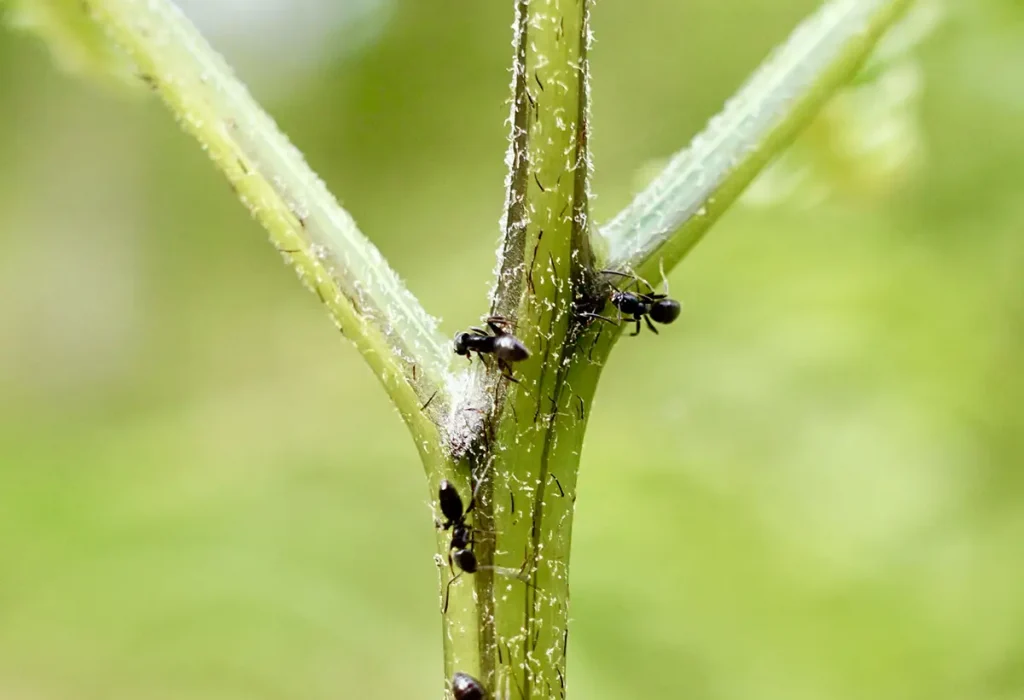
Ants crawling on a green stem

by Randall Brown

Collaborations across research disciplines can lead to unexpected breakthroughs and discoveries. Collaborations across species lead to unexpected evolutionary paths of mutual benefit.

For example, some plants have managed to recruit ant bodyguards. They produce sugary nectar on their leaves that attracts the ants, then these very territorial and aggressive ant mercenaries patrol “their” plant and sting or bite herbivores that try to eat it.

These relationships are well-documented in flowering plants, but they also occur in non-flowering ferns. This is weird news for researchers, as it has long been thought that ferns lack the nectaries for such complex biotic interactions.

Jacob Suissa, assistant professor in the UT Department of Ecology and Evolutionary Biology, worked with colleagues at Cornell University, including fern expert Fay-Wei li and ant expert Corrie Moreau, to investigate how this phenomenon developed over the millennia. They recently published findings in Nature Communications about the evolutionary timeline and underlying factors of this interspecies partnership.

“The new elements of this work are twofold,” explained Suissa. “First, we discovered that nectaries—the structures that produce sugary nectar to attract ant bodyguards—evolved in ferns and flowering plants around the same time.”

This happened some 135 million years ago, coinciding with the rise of plant-ant associations in the Cretaceous period. 

“This timing is quite spectacular given that it is very late in fern evolutionary history, nearly 200 million years after their origin,” said Suissa. “But it’s very early in flowering plant evolutionary history, nearly at the start of their origin in the Cretaceous.”

The second new element is how it all happened. Ferns originally flourished as terrestrial plants, growing on the forest floor. They transitioned in a major way in the Cenozoic Era, around 60 million years ago, becoming epiphytic, or tree dwelling, plants.

They learned some new habits on their way up.

“We discovered that as ferns left the forest floor and moved into the canopies, either as epiphytes, climbers, or tree ferns, they tapped into the existing ant-flowering plant interactions and evolved nectaries,” said Suissa.

This presents a curious dynamic in the ecological and evolutionary history of these two plant lineages. Ferns and flowering plants diverged from a common ancestor more than 400 million years ago, but then hit their stride in parallel with their nectary evolution and the mutually beneficial ant-plant tradeoff.

“This suggests that there may be some ‘rules of life’ governing the evolution of non-floral nectaries and ant-plant mutualism,” said Suissa. “This work can help future investigations by providing the evolutionary framework or backdrop for ecological, developmental, or genomic analyses.”

Read Suissa’s full paper, “Convergent evolution of nectaries in ferns facilitated the independent recruitment of ant-bodyguard from flowering plants,” in Nature Communications.

Filed Under: Faculty, faculty, Featured

Faculty Recognized for Excellence in Teaching, Service, and Academic Outreach

March 27, 2024 by Logan Judy

Faculty Recognized for Excellence in Teaching, Service, and Academic Outreach

During the 2023 UT College of Arts and Sciences faculty convocation, EEB faculty received awards for excellence in teaching, research, and academic outreach. 

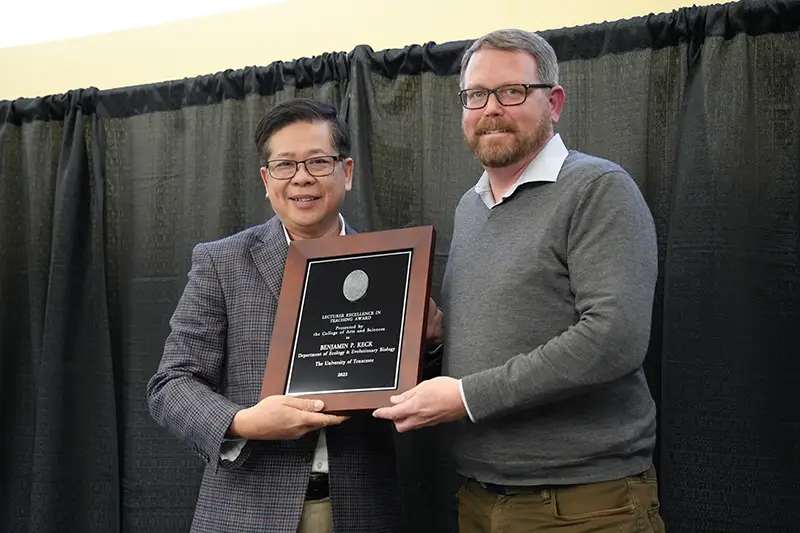
Benjamin Keck, Lecturer – Excellence in Teaching Awards: Lecturer

Benjamin Keck is presented with an award by Liem Tran at the Faculty Awards Ceremony

Ben Keck is an outstanding and dedicated lecturer for the University of Tennessee who has supported student learning in the classroom, in the field, and in the lab for many years. His teaching practice stands out for his high level of innovation, enthusiasm, and positive course climate.

Keck is a dedicated undergraduate teacher of both introductory biology courses and upper-level majors courses. His appointment is across two units—general biology and EEB—and he makes a huge contribution both as a teacher and a mentor to students. As the Director of the Ichthyology Collection at UT, Keck also makes outstanding contributions to community outreach efforts to highlight the diversity and importance of fishes in Eastern Tennessee.


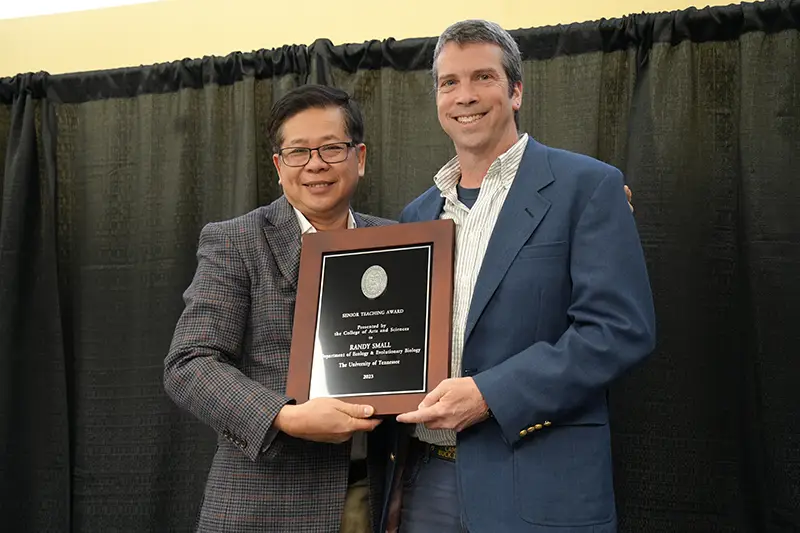
Randy Small, Professor – Excellence in Teaching Awards: Senior

Randy Small is presented with an award by Liem Tran at the Faculty Awards Banquet

Randy Small is a full professor in EEB and has been the director for Teaching and Learning in the Division of Biology since 2019. His first rate and long-standing contributions to the educational mission of the College of Arts and Sciences makes him the perfect winner of this award. Legions of students in EEB as a department and the whole Division of Biology have benefited from Small’s dedication to student success, outstanding teaching practice, and educational vision and leadership. This award is long overdue.


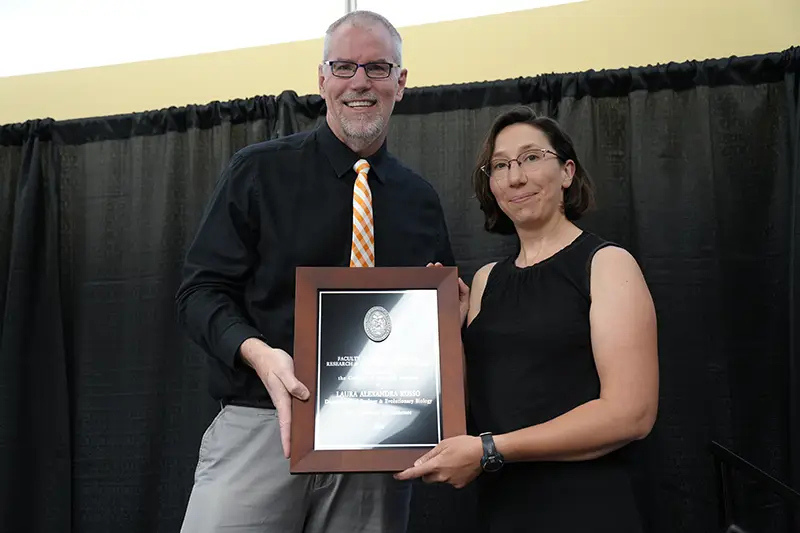
Laura Alexandra Russo, Assistant Professor – Faculty Academic Outreach Award: Research & Creative Activity

Laura Alexandra Russo is presented with an award at the Faculty Awards Ceremony

Russo is an outstanding faculty member in the Department of Ecology and Evolutionary Biology whose outreach has raised the profile of UT Knoxville scientifically and to the public. Her research engages the public, community groups, state agencies, students, and others to tackle declines in bee species and other pollinators and what can be done to reverse these trends. Her approach exemplifies engaged scholarship that is conducted with and in communities.

Russo regularly leads outreach events at state parks like Seven Islands and Roan Mountain and national parks like the Great Smoky Mountains, including pollinator and plant hikes and bioblitzes in which community members find, identify, and document biodiversity. She actively engages with UT Extension, giving seminars and running outreach events at UT’s research and education centers across the state.


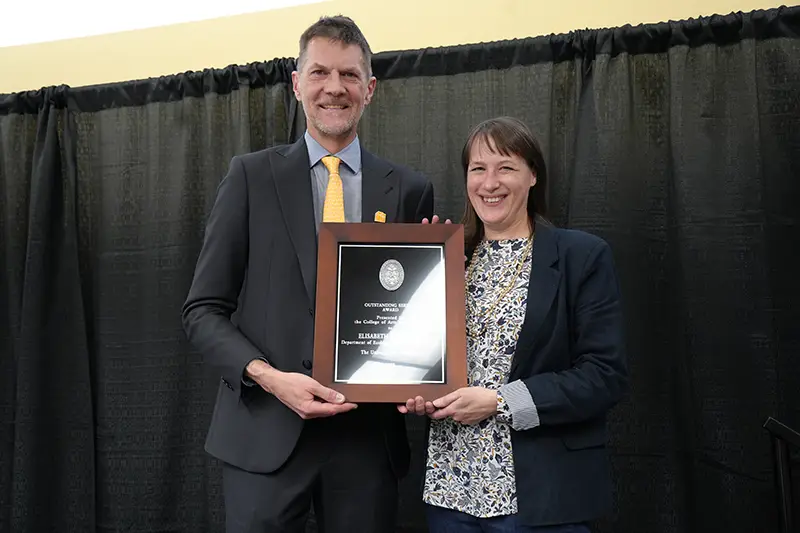
Elisabeth Schussler, Professor – Outstanding Service Award

Elisabeth Schussler is presented an award by Robert Hinde at the Faculty Awards Ceremony

In her role as Director of Biology Teaching and Learning, Professor Schussler ensures our students in the lower-division biology courses receive excellence instruction from our graduate teaching assistants and nontenure-track faculty. 

She provides professional development opportunities for instructors to be at the top of their teaching game and it is this passion for high-quality teaching across the natural sciences that led her to build teams of faculty members across the college and university who also want high-quality instruction in lower-level courses. As Faculty Senate president, she supported the ideas of liberal arts learning through cultivation of a strong shared governance process. 

Filed Under: faculty, Faculty, Featured

Kimberly Sheldon’s Research Featured on CBS

February 28, 2024 by Logan Judy

Kimberly Sheldon’s research on climate change effects on dung beetles was featured on CBS Saturday Morning, as part of a segment on insect declines in the Anthropocene.

Filed Under: faculty, Faculty, Featured, MAIN, Sheldon

American Academy of Microbiology Colloquium: Microbes in Models Final Report

June 7, 2023 by ldutton

EEB’s Dr. Stephanie Kivlin joins her collaborators in announcing the release of their new report, “Microbes in Models.” Climate change threatens all life on Earth. The report outlines top challenges to overcome to better incorporate microbial processes into Earth system models and improve model projections that inform climate change mitigation actions. Read more here: https://eeb.utk.edu/wp-content/uploads/2023/06/Microbes-in-Models-Report_FINAL.pdf 

Filed Under: climate change, ecology, extinction, faculty, Kivlin, MAIN

EEB Spring 2023 Awards Video

May 31, 2023 by ldutton

Faculty, staff and students from EEB gathered on May 18, 2023 to celebrate the end of the semester, recognize award-winners, and honor retirees. Check out this YouTube video to see all of the winners, along with some photos from the celebration.

https://www.youtube.com/watch?v=CzOlHjXd_pY

Filed Under: Armsworth, award, Bailey, bats, behavior, Derryberry, ecology, Emeritus, events, faculty, Fefferman, Fordyce, Gaoue, Gavrilets, Giam, Gilchrist, Graduate Students, graduation, GREBE, herbarium, Hughes, Kwit, MAIN, Matheny, McCracken, O'Meara, Papes, Research Staff, Riechert, Schussler, Schweitzer, Sheldon, Simberloff, Small, staff, undergraduate

Tiny Fish Makes Big Splash

May 31, 2023 by ldutton

Read about Dr. David Etnier’s Snail Darter legacy here:

https://higherground.utk.edu/snail-darter/

Filed Under: alumni, award, conservation, ecology, Emeritus, extinction, faculty, fish, Former Faculty, Former Graduate Students, Graduate Students, MAIN, O'Meara

EEB Faculty Awarded

March 6, 2023 by ldutton

Three of EEB’s own faculty members, Nina Fefferman, Orou Gaoue, and Xingli Giam, were honored with awards at the recent College of Arts and Sciences Faculty Awards Night. 

Nina Fefferman was recognized with the Academic Outreach Award for Service – she was not able to attend the ceremony, as she was doing more of the pandemic preparedness / response work for which she was honored.

Orou Gaoue was recognized with the Academic Outreach Award for Research and Creative Activity. 

Xingli Giam was recognized with the Early Career Excellence in Research and Creative Achievement  award. 

Congratulations to these faculty members! 

Filed Under: award, ecology, Faculty, faculty, Fefferman, Gaoue, Giam, MAIN, Uncategorized

Investigating New Digital Authorities

February 9, 2023 by wpeeb

In the years since social media became part of our daily lives, an increased number of individuals are self-organizing online around identity, social topics, and various other interests. This transition leads to a new type of cultural authority and one that researchers are investigating to understand how the online human world interacts with the offline human world at both the individual and collective level. 

Sergey Gavrilets, Distinguished Professor in the UT Department of Ecology and Evolutionary Biology, received a grant from the John Templeton Foundation to research the emergence of these new digital authorities on social media. The $1.2 million grant is the largest Templeton Foundation award in UT history.

“I’ve always been puzzled by how presumably reasonable people can come up with completely different strong beliefs or understandings about the same events or processes that happened or are happening in different situations affecting their personal life or our society,” Gavrilets said. “Over the last couple of years, with the 2020 elections and COVID, these differences have become particularly striking and their real and potential consequences particularly dangerous.”

The big question he wants to answer? “How are contemporary social media changing human social and cultural evolution?”

Understanding How New Authorities Develop

Gavrilets and colleague Neil Johnson from the George Washington University will leverage recent work on online behaviors to build a new understanding of how these new authorities develop and function. They will look at how these new authorities contribute to cultural polarizations and how their efforts and impacts are influenced. 

“We will study the emergence of self-organized groups spouting extremism, hate, and vaccine hesitancy within and across social media platforms,” Gavrilets said. “We will look at their structure and try to understand how its composition defines who listens and how these new identity groups emerge.”

Gavrilets, a mathematical biologist whose work focuses on human social behavior, will borrow ideas and theoretical tools from ecology and evolutionary biology and apply them to human social behaviors online. 

“This work will not only help us to understand online human social behaviors better, but also how our attitudes and beliefs are shaped,” said Gavrilets, who also is the director of the Center for the Dynamics of Social Complexity at UT.

“Misinformation about science, climate change, vaccination, COVID, and political processes and events has a potential to affect the life, prosperity, and wellbeing of everyone in a negative way,” Gavrilets said. “By understanding how new social and cultural authorities are formed online, we can develop better policies for governments and businesses to counter misinformation and simultaneously promote public understanding of science-based policies aiming to improve our life and prosperity.”

To learn more, read the full project summary online. 

About the John Templeton Foundation

Founded in 1987, the John Templeton Foundation supports research and catalyzes conversations that inspire people with awe and wonder. They fund work on subjects ranging from black holes and evolution to creativity, forgiveness, and free will. They also encourage civil, informed dialogue among scientists, philosophers, theologians, and the public at large. Their aspiration is to help people create lives of meaning and purpose and to become a global catalyst for discoveries that contribute to human flourishing.

With an endowment of $3.8 billion and annual giving of approximately $140 million, the Foundation ranks among the 25 largest grantmaking foundations in the United States. Headquartered outside Philadelphia, their philanthropic activities have engaged all major faith traditions and extended to more than 57 countries around the world.

Filed Under: faculty, Faculty, Gavrilets, MAIN

Dung beetle mothers protect their offspring from a warming world by digging deeper

November 11, 2022 by wpeeb

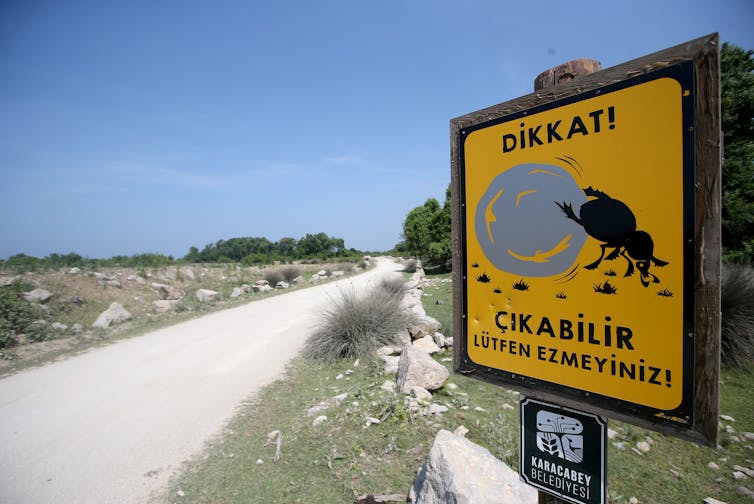
A road sign in Bursa, Turkey, warns drivers of the presence of dung beetles, stating ‘Attention! It may come out, don’t crush it please!’
Ugur Ulu/Anadolu Agency via Getty Images

Kimberly S. Sheldon, University of Tennessee

If the TV series “Dirty Jobs” covered animals as well as humans, it would probably start with dung beetles. These hardworking critters are among the insect world’s most important recyclers. They eat and bury manure from many other species, recycling nutrients and improving soil as they go.

Dung beetles are found on every continent except Antarctica, in forests, grasslands, prairies and deserts. And now, like many other species, they are coping with the effects of climate change.

I am an ecologist who has spent nearly 20 years studying dung beetles. My research spans tropical and temperate ecosystems, and focuses on how these beneficial animals respond to temperature changes.

Insects don’t use internally generated heat to maintain their body temperature. Adults can take actions such as moving to warmer or colder areas. However, earlier life stages such as larvae are often less mobile, so they can be strongly affected by changing temperatures.

But dung beetles appear to have a defense: I have found that adult dung beetles modify their nesting behaviors in response to temperature changes by burying their brood balls deeper in the soil, which protects their developing offspring.

Without dung beetles, the world would be messier and smellier.

Champion recyclers

It’s easy to joke about these busy insects, but by collecting and burying manure, dung beetles provide many ecological benefits. They recycle nutrients, aerate soil, lessen greenhouse gas emissions from cattle farming and reduce pest and parasite populations that harm livestock.

Dung beetles are also important secondary seed dispersers. Dung from other animals, such as bears and monkeys, contains seeds that the beetles bury underground. This protects the seeds from being eaten, makes them more likely to germinate and improves plant growth.

There are roughly 6,000 species of dung beetles around the world. Most feed exclusively on dung, though some will feed on dead animals, decaying fruit and fungi.

Some species use stars and even the Milky Way to navigate along straight paths. One species, the bull-headed dung beetle (Onthophagus taurus), is the world’s strongest insect, able to pull over 1,000 times its own body weight.

That strength comes in handy for dung beetles’ best-known behavior: gathering manure.

Rolling and tunneling

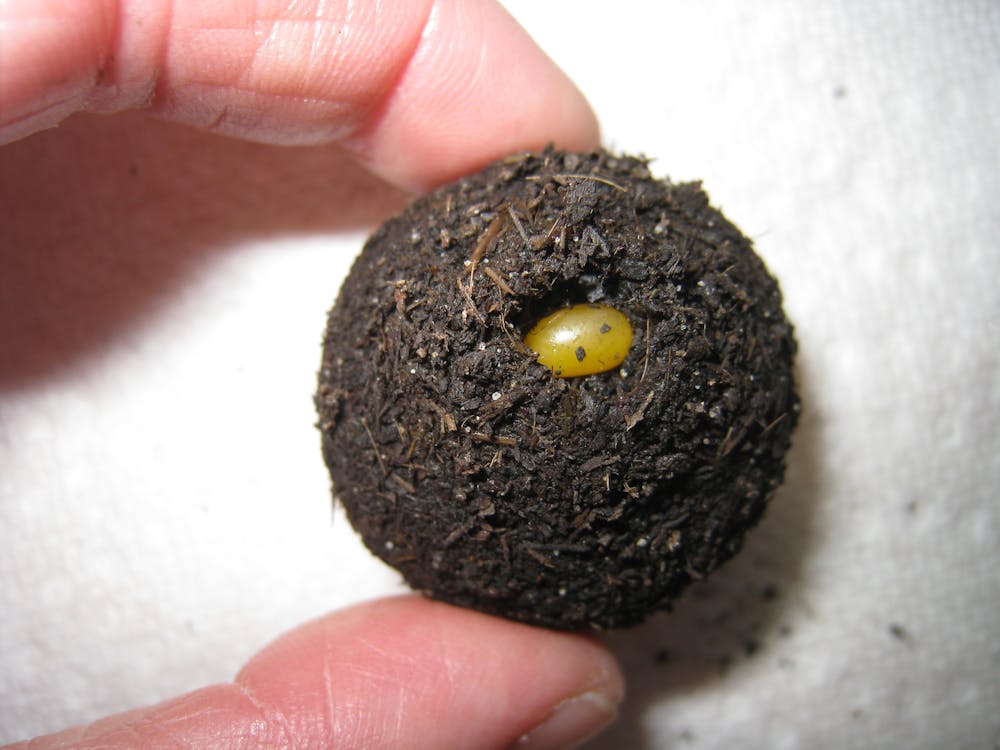
Most popular images of dung beetles show them collecting manure and rolling it into balls to spirit away. In fact, some species are rollers and others are tunnelers that dig into the ground under a dung pat, bring dung down into the tunnel and pack it into a clump or sphere, called a brood ball. The female then lays an egg in each brood ball and backfills the tunnel with soil. Rollers do the same once they get their dung ball safely away from the competition.

Two human fingers grasp a pingpong ball-size dung ball with a fingernail-size egg embedded in the surface
An egg is visible in the center of a brood ball from a female rainbow scarab beetle (Phanaeus vindex).
Kimberly Sheldon, CC BY-ND

When the egg hatches, the larva feeds on dung from the brood ball, pupates and emerges as an adult. It thus goes through complete metamorphosis – from egg to larva to pupa to adult – inside the brood ball.

Warmer temperatures produce smaller beetles

Dung beetle parents don’t provide care for their offspring, but their nesting behaviors affect the next generation. If a female places a brood ball deeper underground, the larva in the brood ball experiences cooler, less variable temperatures than it would nearer the surface.

This matters because temperatures during development can affect offspring survival and other traits, such as adult body size. If temperatures are too hot, offspring perish. Below that point, warmer, more variable temperatures lead to smaller-bodied beetles, which can affect the next generation’s reproductive success.

Smaller males can’t compete as well as larger males, and smaller females have lower reproductive output than larger females. In addition, smaller-bodied beetles remove less dung, so they provide fewer benefits to humans and ecosystems, such as nutrient cycling.

Beetles in the greenhouse

Climate change is making temperatures more variable in many parts of the world. This means that insects and other species have to handle not just warmer temperatures, but greater changes in temperature day to day.

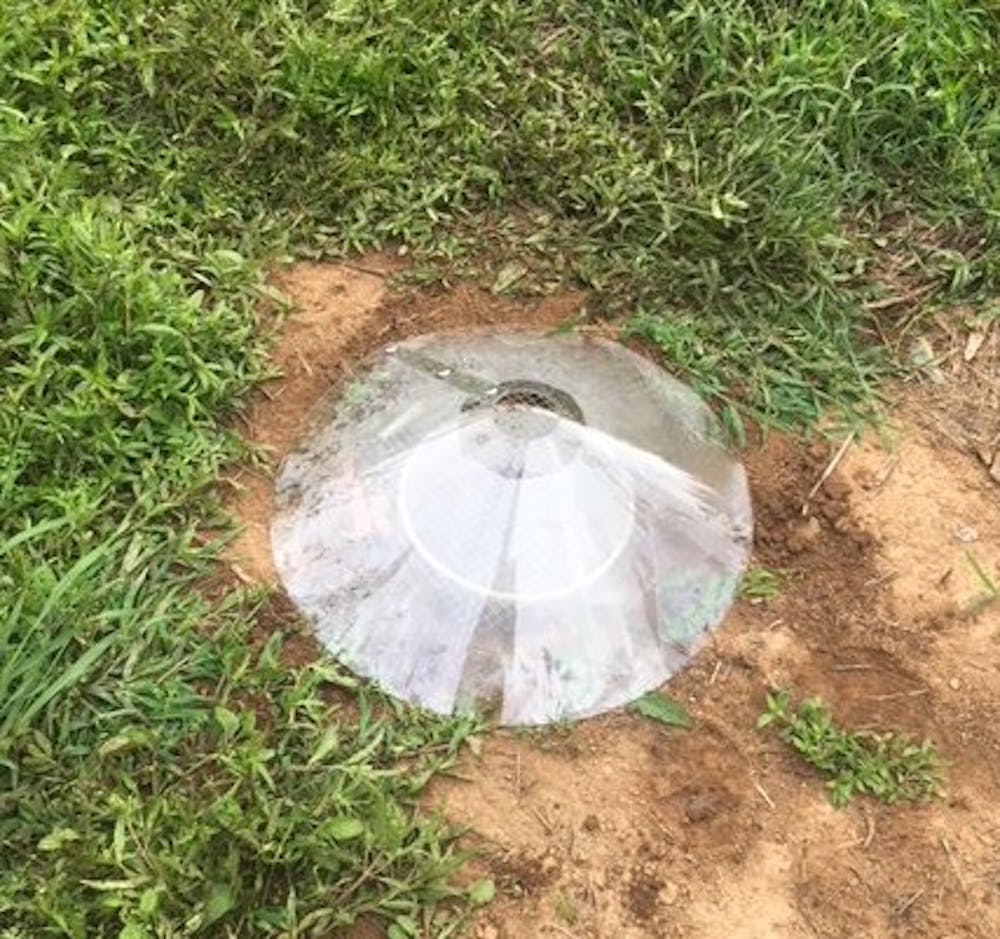
To examine how adult dung beetles responded to the types of temperature shifts associated with climate change, I designed cone-shaped mini-greenhouses that would fit over 7-gallon buckets buried in the ground to their brims. Will Kirkpatrick, an undergraduate student in my lab, led the field trials.

We randomly placed a fertilized female rainbow scarab, Phanaeus vindex, in each greenhouse bucket and in the same number of uncovered buckets to serve as controls. Using temperature data loggers placed at four depths in the buckets, we verified that soil temperatures in “greenhouse” buckets were warmer and more variable than soil temperatures in uncovered buckets.

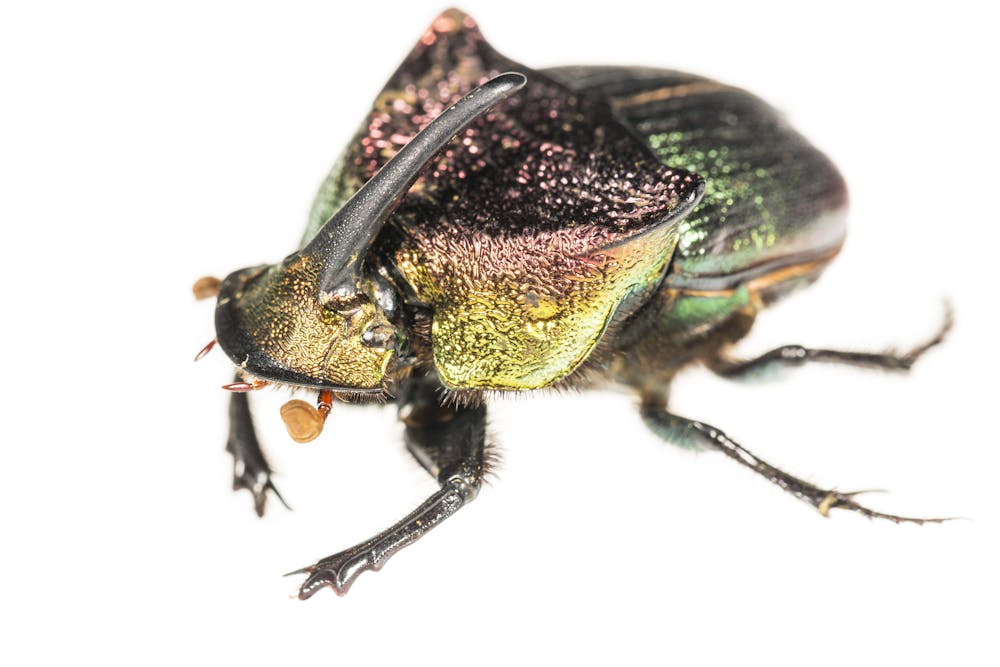
A large round beetle with red, green and gold shading
A male rainbow scarab dung beetle (Phanaeus vindex).
Dan Mele, CC BY-ND

We gave the beetles fresh cow dung every other day for 10 days and allowed them to make brood balls. Then we carefully dug through the buckets and recorded the number, depth and size of brood balls in each bucket.

Digging deeper

We found that beetle mothers in greenhouse environments created more brood balls overall, that these brood balls were smaller, and that these females buried their brood balls deeper in the soil than beetle mothers in control buckets. Brood balls in the greenhouses still ended up in areas that were slightly warmer than those in the control buckets – but not nearly as warm as if the beetle mothers had not altered their nesting behaviors.

A cone-shaped cover placed in a patch of dirt
A dung beetle greenhouse placed over a buried bucket of soil in the author’s field trial.
Kimberly Sheldon, CC BY-ND

However, by digging deeper, the adults fully compensated for temperature variation. There was no difference in the temperature variation experienced by brood balls in greenhouse buckets and control buckets. This reflects the fact that soil temperatures become increasingly stable with depth as the soil becomes more and more insulated from the changing air temperatures above it.

Our findings also hint at a possible trade-off between burial depth and brood ball size. Beetle mothers that dug deeper protected their offspring from temperature changes but provided less dung in their brood balls. This meant less nutrition for developing offspring.

Climate change could still affect adult dung beetles in ways we did not test, with consequences for the next generation. In future work, we plan to place brood balls of Phanaeus vindex and other species of dung beetles back into the greenhouse and control buckets at the depths at which they were buried so that we can see how the beetle offspring develop and survive.

So far, though, my colleagues and are encouraged to find that these industrious beetles can alter their behavior in ways that may help them survive in a changing world.The Conversation

Kimberly S. Sheldon, Associate Professor of Ecology and Evolutionary Biology, University of Tennessee

This article is republished from The Conversation under a Creative Commons license. Read the original article.

Filed Under: faculty, MAIN

  • « Previous Page
  • 1
  • 2
  • 3
  • 4
  • …
  • 6
  • Next Page »

Recent Posts

  • Environmental Policy Collaboration Earns Research Award
  • Bees of many species contain tiny magnetic particles – suggesting they may have an innate magnetic compass for navigation
  • UT Faculty are Trailblazing New Evolutionary Research
  • How “Fire Fungi” Help Put Burnt Landscapes Back Together
  • Research Shows Warming Impact on Soil Ecosystem

Recent Comments

No comments to show.

College of Arts & Sciences

117 Natalie L. Haslam Music Center
1741 Volunteer Blvd.
Knoxville TN 37996-2600

Phone: 865-974-3241

Archives

  • August 2026
  • July 2026
  • March 2026
  • February 2026
  • January 2026
  • December 2025
  • November 2025
  • October 2025
  • September 2025
  • August 2025
  • July 2025
  • April 2025
  • March 2025
  • February 2025
  • January 2025
  • November 2024
  • October 2024
  • August 2024
  • July 2024
  • June 2024
  • May 2024
  • April 2024
  • March 2024
  • February 2024
  • December 2023
  • November 2023
  • October 2023
  • September 2023
  • August 2023
  • July 2023
  • June 2023
  • May 2023
  • April 2023
  • March 2023
  • February 2023
  • January 2023
  • December 2022
  • November 2022
  • August 2022
  • June 2022
  • April 2022
  • March 2022
  • October 2021
  • August 2021
  • June 2021
  • April 2021
  • February 2021
  • January 2021
  • December 2020
  • November 2020
  • September 2020
  • August 2020
  • June 2020
  • May 2020
  • March 2020
  • February 2020
  • January 2020
  • December 2019
  • November 2019
  • October 2019
  • September 2019
  • August 2019
  • April 2019
  • March 2019
  • November 2018
  • June 2018
  • May 2018
  • April 2018
  • March 2018
  • February 2018
  • January 2018
  • December 2017
  • November 2017
  • October 2017
  • September 2017
  • August 2017
  • July 2017
  • June 2017
  • May 2017
  • April 2017
  • March 2017
  • February 2017
  • January 2017
  • December 2016
  • November 2016
  • October 2016
  • September 2016
  • August 2016
  • July 2016
  • June 2016
  • May 2016
  • April 2016
  • March 2016
  • February 2016
  • January 2016
  • December 2015
  • November 2015
  • October 2015
  • September 2015
  • August 2015
  • July 2015
  • June 2015
  • April 2015
  • March 2015
  • February 2015
  • January 2015
  • November 2014
  • October 2014
  • September 2014
  • August 2014
  • July 2014
  • June 2014
  • May 2014
  • April 2014
  • March 2014
  • February 2014
  • January 2014
  • December 2013
  • November 2013
  • October 2013
  • September 2013
  • August 2013
  • July 2013
  • June 2013
  • May 2013
  • April 2013
  • March 2013
  • January 2013
  • December 2012
  • October 2012
  • September 2012
  • August 2012
  • June 2012
  • May 2012
  • April 2012
  • March 2012
  • February 2012
  • January 2012
  • December 2011
  • October 2011
  • September 2011
  • August 2011
  • July 2011
  • June 2011
  • May 2011
  • April 2011
  • March 2011
  • February 2011
  • January 2011
  • November 2010

Categories

  • Adjunct
  • alumni
  • ants
  • Armsworth
  • Auerbach
  • Australia
  • award
  • Bagby
  • Bailey
  • Baker Center
  • Banbury
  • bats
  • behavior
  • Blum
  • Boake
  • book
  • Boyer
  • Budke
  • Burghardt
  • citizen science
  • Classen
  • climate change
  • conservation
  • corker
  • course
  • damage
  • Darwin Day
  • DDIG
  • Derryberry
  • DeSelm
  • DOE
  • Echternacht
  • ecology
  • education
  • Emeritus
  • endowment
  • EOL
  • EUReCA
  • events
  • extinction
  • facilities
  • faculty
  • Faculty
  • Featured
  • Fefferman
  • fellowship
  • field course
  • fish
  • Fitzpatrick
  • Fordyce
  • Former Faculty
  • Former Graduate Students
  • fundraiser
  • fungi
  • Gaoue
  • Gavrilets
  • Giam
  • Gilchrist
  • graduate
  • Graduate Students
  • graduation
  • grant
  • Great Smoky Mountains NP
  • GREBE
  • greenhouse
  • Gross
  • Hallam
  • head
  • Hemingway
  • herbarium
  • Hughes
  • Hulsey
  • human evolution
  • intern
  • invasive
  • jobs
  • Kalisz
  • Kivlin
  • Kwit
  • MAIN
  • math
  • Matheny
  • McCracken
  • media
  • modeling
  • National Academy of Sciences
  • Nature
  • NCEAS
  • NEON
  • News Sentinel
  • newsletter
  • newspaper
  • NIMBioS
  • NSF
  • Nyari
  • O'Meara
  • obituary
  • ORNL
  • outreach
  • Papes
  • Petersen
  • placement
  • plos one
  • PNAS
  • podcast
  • popular media
  • postdoc
  • publication
  • Research Staff
  • REU
  • Riechert
  • Rstats
  • Russo
  • Sanders
  • Schilling
  • Schussler
  • Schweitzer
  • Science
  • SciFest
  • seminar
  • Sheldon
  • Simberloff
  • slate
  • Small
  • staff
  • STEM
  • Stockmaier
  • Suissa
  • summer
  • Tanner
  • taxonomy
  • teaching
  • TennesseeToday
  • Uncategorized
  • Undergrad News
  • undergraduate
  • wildflower pilgrimage
  • Williams
  • WNS
  • Wofford

Copyright © 2026 · University of Tennessee, Knoxville WDS Genesis Child on Genesis Framework · WordPress · Log in

Ecology & Evolutionary Biology

College of Arts and Sciences

569 Dabney Hall
Knoxville TN 37996-1610

Email: eeb@utk.edu

Phone: 865-974-3065

The University of Tennessee, Knoxville
Knoxville, Tennessee 37996
865-974-1000

The flagship campus of the University of Tennessee System and partner in the Tennessee Transfer Pathway.

ADA Privacy Safety Title IX