• Request Info
  • Visit
  • Apply
  • Give
  • Request Info
  • Visit
  • Apply
  • Give

Search

  • A-Z Index
  • Map

Ecology & Evolutionary Biology

  • About
    • Give to EEB
    • Alumni
  • People
    • Faculty
    • Emeritus
    • Graduate Students
    • Adjunct
    • Postdocs
    • Research Staff
    • Administrative Staff
  • Undergraduate Students
    • EEB Concentration in Biology
    • EEB Minor
    • Honors
    • Course Descriptions
    • Naturalists Club
    • Fellowships
    • Be successful in EEB
  • Graduate Students
    • Graduate Student Handbook
    • FAQs
    • Applying to Grad School
    • GREBE
    • Funding
  • Research and Outreach
    • Research Highlights
    • Undergraduate Research Opportunities
    • Outreach Events
  • Collections and Facilities
    • UT Herbarium
    • UT Etnier Ichthyology Collection
    • Hesler Biology Greenhouses
    • Natural History Collections Course
    • Fellowships and Awards
    • Biology Field Station
  • News & Seminars
    • Current Seminars
    • News
    • Newsletter
Home » newsletter » Page 7

newsletter

Williams Explores the History of Plant Life Histories

November 3, 2016 by wpeeb

Botany Magazine CoverAs an undergraduate, Joe Williams became fascinated by the often bizarre ways plants have sex.

“Who would have thought that the Ginkgo tree shedding pollen in the back yard was actually sending out tiny plants inside its pollen grains?” says Williams, professor of plant evolutionary biology and chair of graduate affairs in EEB.

As a student, Williams realized the complexity of reproduction in flowering plants might cause evolution to happen faster.

“Pollen competes for access to eggs, and competition is much more intense in flowering plants than in other seed plants like the Ginkgo, because plants with flowers are so often insect-pollinated,” says Williams. “Each insect visit brings a lot of pollen grains to a flower, which all start the race to the egg at the same time.”

Williams has worked over the past 15 years reconstructing ancient aspects of pollen performance in flowering plants. Because scientists are unable to study pollen competitive ability in the fossil record, Williams focused on living proxies within ancient extant lineages of flowering plants.

“If I could choose one word to describe the performance of pollen from these species, it would be slow!” says Williams.

Now, Williams is interested in the role of pollen in how the big winners in flowering plant evolution – weeds and annuals – evolved their exceptionally rapid life histories.

Filed Under: newsletter

Founding EEB Department Member Jim Drake Retires

November 3, 2016 by wpeeb

Jim DrakeJim Drake, who recently retired from EEB, spent his entire professional career at UT after receiving his bachelor’s degree at the University of Wisconsin and doctorate at Purdue, followed by a post-doctoral stint at Stanford. Drake began his career as an assistant professor in the Department of Zoology and the ecology graduate program beginning in 1986 and was a founding member of the EEB department when it was formed in 1992.

Drake’s interests centered on the assembly and structure of ecological communities. He helped organize the international program of the Scientific Committee on Problems of the Environment, which triggered the new field of invasion biology. Drake also edited the two highly influential books from that program: Ecology of Biological Invasions of Hawaii and North America (1986) and Biological Invasions: A Global Perspective (1989). In addition, he was editor-in-chief of the leading journal in the field, Biological Invasions, from 2003 through 2008.

Professor Drake and his students performed many experiments on community assembly in aquatic systems, particularly microcosms containing communities of microorganisms, that elucidated such questions as whether the order in which species arrive in a site helps determine which ones will persist in the community. His research on theoretical aspects of community structure and assembly is well known and includes some of the pioneering work on emergent properties of complex ecological systems and on the relationship of food web topological complexity to stability. Drake’s research on complexity and community stability, as well as on the impact of biological invasions, led him to increasing interest in conservation biology and determinants of biodiversity, which was featured in Biodiversity Dynamics: Turnover of Populations, Taxa, and Communities (1998).

Drake left a lasting imprint on EEB and on the fields of invasion biology and community ecology. The EEB students he guided are scattered among leading institutions worldwide and continue to make strong contributions in these fields.

According to a review from RateMyProfessor.com: “Professor Drake could be one of the most interesting people I have ever met. The man is awesome and a dying breed of professors. He doesn’t want you to just memorize facts. He wants you to think, to hypothesize, and to be a scientist.”

Contributed by Gore Hunger Professor of Environmental Science Dan Simberloff

Filed Under: newsletter

Wofford Leaves Behind True Legacy at UT

November 3, 2016 by wpeeb

Gene Wofford The cotyledons of a tulip tree (Liriodendron tulipifera) emerging from east Tennessee soil in 1970 would have by now produced an imposing tree, approaching a half century in age. Nineteen-seventy also would see a young PhD candidate from middle Tennessee arrive on the University of Tennessee, Knoxville campus and begin his studies in the botany department. This past summer that young graduate student, Research Associate Professor B. Eugene Wofford (Gene), stepped down as full time director of the University of Tennessee Herbarium, leaving a legacy as one of the most accomplished botanists to graduate, teach, and conduct his research through the UT Department of Botany, (now the Department of Ecology & Evolutionary Biology).

To celebrate Gene’s career is to recognize his many contributions to Tennessee botany, where he studied one of the most diverse floras in the world. He mastered this diverse flora and authored or co-authored four of the most definitive treatises of the flora of Tennessee, including A Guide to the Vascular Plants of the Blue Ridge, Guide to the Trees, Shrubs and Woody Vines of Tennessee, Woody Plants of Kentucky and Tennessee, and The Guide to the Vascular Plants of Tennessee; a work guided by Wofford with the Tennessee Flora Committee. Perhaps surpassing his written accomplishments through his books and scientific papers is his lifetime of collaboration with his botany peers worldwide through his directorship of the University of Tennessee Herbarium, one of the top 25 Herbaria in the United States and the primary repository of plants collected from Tennessee and the Great Smoky Mountains National Park.

Few can retire knowing they left a true legacy, but one only has to look at all the UT graduates Wofford taught and mentored who now continue the legacy of Tennessee botany as professors, researchers, and environmental professionals throughout the greater Southeast to recognize his lasting legacy.

Wofford also leaves his mark through his leadership of the Spring Wildflower Pilgrimage, the Association of Southeastern Biologists, and the Southern Appalachian Botanical Society, which honored him with their most prestigious award, the Elizabeth Ann Bartholomew Award, in 2004.

As scientific technologies change, as climates change, and as scientific understanding changes, the value of botanical collections to the sagacious is becoming even more apparent. Thank you, Gene, for your stewardship of Tennessee botany and the collections housed in the UT Herbarium.

Contributed by W. Michael Dennis (PhD Botany, ’76)

Filed Under: newsletter

EEB Community Continues to Grow

November 3, 2016 by wpeeb

Susan Kalisz It has been an exciting year in EEB. Our department has grown on many fronts. First, we have recruited lots of great new people. I’d like to extend a warm welcome to the five new faculty who are joining us during the 2016-17 academic year: Associate Professor Nina Fefferman and Assistant Professors Jessica Budke, Kimberly Sheldon, Mona Papes, and Xingli Giam. Jessica Budke is also the new director of the Tennessee Herbarium (TENN), stepping in as Gene Wofford retires after 40 excellent years at the helm of TENN. Jim Drake has also retired after 29 years of service to the university. Enhancements to the greenhouse facilities at Hesler and Senter Halls also include a new management team. I welcome Jeff Martin who serves as the greenhouse manager with assistance from Benny Crain, our new lecturer. Benny Crain is creating the new BIO 150 lab curriculum. Our greenhouse facility is expanding research and teaching capacity under Jeff’s management.

The remarkable community of EEB scientists and scholars continues to shine and impress. Our faculty received university, regional, and international awards including Beth Schussler’s UT Alumni Outstanding Teacher Award, Paul Armsworth’s Cox Professorship, Susan Riechert’s 2016 SEC Faculty Achievement Award, and the International Biogeographic Society Board’s Alfred Russel Wallace Award to Dan Simberloff. Postdoc Mason Heberling received a highly competitive two-year NSF postdoctoral fellowship.

EEB grad and undergraduate students are amazing! One quarter of our 56 grad students are self-funded, awarded over $300,000 in fellowship support last year alone. They published more than 80 papers in scientific journals, presented 50 talks and seminars at meetings, and share their enthusiasm for science through outreach to the community. Jess Welch was one of six to receive the Ecological Society of America’s Graduate Student Policy Award. EEB undergraduate alumna Kenna Rewcastle (’15) was awarded a Fulbright US Student Program Grant for 2016–17 to conduct research on climate change impacts on the reindeer herds’ food sources managed by the Sami indigenous people of Sweden. Learn more about the amazing achievements of our students, faculty, and staff in the Awards and Accolades section of this newsletter.

On a personal level, I have been delighted, charmed and inspired by my colleagues in EEB and across the university and their culture of inclusion. I have enjoyed exploring the Scruffy City, the beautiful East Tennessee and Smoky Mountains landscape, and experiencing the glorious biodiversity showcased by the Spring Wildflower Pilgrimage. I can hardly believe I have only been at UT for one year!

Filed Under: newsletter

Geckos, Salamanders, and Salmonella Research

November 3, 2016 by wpeeb

Jacob WesselsJacob Wessels, an undergraduate in EEB working in the Fitzpatrick Lab, is focused on the population ecology of the nonnative Mediterranean geckos, which have established populations throughout much of the southern United States and have been expanding their range northward largely through unintentional transport by people.
Recently, a population was discovered in Knoxville, which is the edge of the range of these Mediterranean geckos. Wessels and a fellow student observed the population size and trend and monitored it to see if they would survive the winter. Using pattern recognition software and the unique dorsal patterns of individual geckos, Wessels established an encounter history. The geckos survived the winter and successfully reproduced, and the model results indicate the population size likely increased.

“During my time at UT, I was fortunate to have opportunities to take part in many other research projects on topics such as salmonella in wildlife around an urban creek, physiology of tiger salamanders, and cave bioinventories, as well as opportunities through the Naturalist Club,” says Wessels, who received the EEB Outstanding Undergraduate Award at the department awards ceremony in May. “In the future, I hope to gain a variety of field experience and to later attend graduate school.”

One of his current interests is avian migration ecology. Directly following his final semester, Wessels took a seasonal field tech position in Minnesota examining migration ecology of Golden-winged and Blue-winged warblers.

“I am excited to continue gaining experience in this area of study and think my time in EEB has given me a solid foundation of knowledge and experience,” says Wessels.

Filed Under: newsletter

Working to Fix the Leaky Pipeline

November 3, 2016 by wpeeb

New professional development engages STEM faculty and graduate students in EEB through research, social networking, and educational events.

Pictured: Dominique Hatton (EEB), Mallory Ladd (Bredesen Center and Pipeline: Vols for Women Chair), Kate Purple (Biomedical and Diagnostic Sciences), Fatemeh Sepehr (Chemical Engineering), Christine Ajinjeru (Bredesen Center), and Susan Kalisz (EEB Department Head and Faculty Advisor of Pipeline: Vols for Women).

A diverse group of graduate and undergraduate students are committed to enhancing the status and representation of women in science, technology, engineering, and math (STEM). Pipeline: Vols for Women in STEM, a committee of the Commission for Women, is named for the sociological term, “leaky pipeline,” which refers to women having an early academic interest in STEM fields, yet fewer women than men end up obtaining STEM degrees or moving on to well-paying STEM careers.

Pipeline aims to serve all academic levels of students by helping to develop students’ careers and providing students with access to a multidisciplinary mentoring program, professional and social networking events, a topical monthly lecture series, and opportunities for community outreach.

The largest and most significant event organized by Pipeline is the annual Women in STEM Research Symposium, which uniquely spotlights academic research conducted by women.

New to Pipeline is the WiSTAR3 subcommittee: Women in STEM Advancing Research, Readiness, and Retention. This professional development program aims to provide a support network to engage both STEM faculty and graduate students through social and educational events. Monthly networking meetings and workshops help prepare women graduate students for careers in advanced research.

Both Pipeline and WiSTAR3 have significant EEB participation. Several faculty members, staff, and graduate students attend the meetings and have leadership positions within the organization.

This year, the UT Division of Student Life recognized the important work of Pipeline: Vols for Women in STEM and honored the group with two awards: New Organization of the Year and Innovative Program of the Year, for the research symposium.


Contributed by Alannie-Grace Grant

Filed Under: newsletter

GREBE in News-Herald

May 11, 2016 by wpeeb

EEB’s GREBE (Graduate Researchers in Ecology, Behavior, and Evolution) was featured in the Knoxville News-Herald newspaper for their recent outreach work teaching students at Greenback School. Sixth-grade students participated in hands-on tasks, including extracting DNA from bananas, watching termites follow different ink colors, and building miniature ecosystems.

Miranda Chen (Schussler Lab) and Dominique Hatton (Riechert Lab) are mentioned by name in the article.

GREBE is a graduate student organization in EEB at the UT that facilitates collaboration between graduate students and provides representation of graduate student interests to the department and college.

Filed Under: graduate, MAIN, newsletter, outreach, Riechert, Schussler

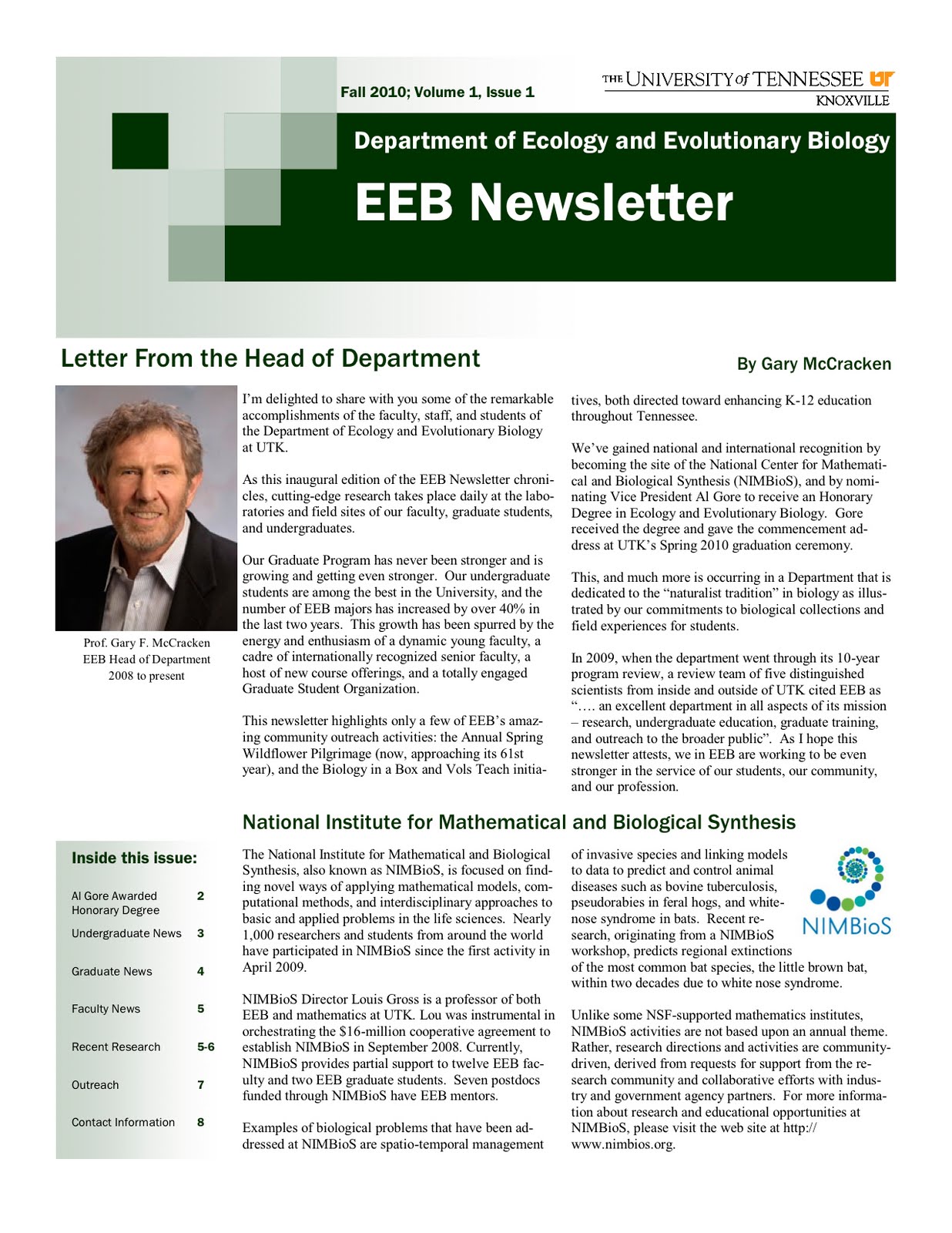
EEB Newsletter

January 27, 2012 by wpeeb

The most recent version of the EEB Newsletter has appeared. You can download a PDF, submit items to the editor, or get an email subscription here.

Filed Under: DeSelm, graduate, greenhouse, MAIN, newsletter, O'Meara, Sanders, undergraduate

EEB Newsletter

January 27, 2012 by wpeeb

The most recent version of the EEB Newsletter has appeared. You can download a PDF, submit items to the editor, or get an email subscription here.

Filed Under: DeSelm, graduate, greenhouse, MAIN, newsletter, O'Meara, Sanders, undergraduate

EEB Newsletter

February 8, 2011 by wpeeb

The first issue of the new EEB newsletter has now appeared. You can download the PDF or email eebnews@utk.edu for more information.

Filed Under: MAIN, newsletter

  • « Previous Page
  • 1
  • …
  • 5
  • 6
  • 7
  • 8
  • Next Page »

Recent Posts

  • EEB Says Goodbye to Sandy Echternacht
  • Scholar Spotlight: Chuck Price
  • Fern Scientist Uncovers How Limits Fuel Evolution
  • Rats! Science Redefines Social Media Sensation
  • Burghardt Paper Earns Biosemiotics Award

Recent Comments

No comments to show.

College of Arts & Sciences

117 Natalie L. Haslam Music Center
1741 Volunteer Blvd.
Knoxville TN 37996-2600

Phone: 865-974-3241

Archives

  • December 2025
  • November 2025
  • October 2025
  • September 2025
  • August 2025
  • July 2025
  • April 2025
  • March 2025
  • February 2025
  • January 2025
  • November 2024
  • October 2024
  • August 2024
  • July 2024
  • June 2024
  • May 2024
  • April 2024
  • March 2024
  • February 2024
  • December 2023
  • November 2023
  • October 2023
  • September 2023
  • August 2023
  • July 2023
  • June 2023
  • May 2023
  • April 2023
  • March 2023
  • February 2023
  • January 2023
  • December 2022
  • November 2022
  • August 2022
  • June 2022
  • April 2022
  • March 2022
  • October 2021
  • August 2021
  • June 2021
  • April 2021
  • February 2021
  • January 2021
  • December 2020
  • November 2020
  • September 2020
  • August 2020
  • June 2020
  • May 2020
  • March 2020
  • February 2020
  • January 2020
  • December 2019
  • November 2019
  • October 2019
  • September 2019
  • August 2019
  • April 2019
  • March 2019
  • November 2018
  • June 2018
  • May 2018
  • April 2018
  • March 2018
  • February 2018
  • January 2018
  • December 2017
  • November 2017
  • October 2017
  • September 2017
  • August 2017
  • July 2017
  • June 2017
  • May 2017
  • April 2017
  • March 2017
  • February 2017
  • January 2017
  • December 2016
  • November 2016
  • October 2016
  • September 2016
  • August 2016
  • July 2016
  • June 2016
  • May 2016
  • April 2016
  • March 2016
  • February 2016
  • January 2016
  • December 2015
  • November 2015
  • October 2015
  • September 2015
  • August 2015
  • July 2015
  • June 2015
  • April 2015
  • March 2015
  • February 2015
  • January 2015
  • November 2014
  • October 2014
  • September 2014
  • August 2014
  • July 2014
  • June 2014
  • May 2014
  • April 2014
  • March 2014
  • February 2014
  • January 2014
  • December 2013
  • November 2013
  • October 2013
  • September 2013
  • August 2013
  • July 2013
  • June 2013
  • May 2013
  • April 2013
  • March 2013
  • January 2013
  • December 2012
  • October 2012
  • September 2012
  • August 2012
  • June 2012
  • May 2012
  • April 2012
  • March 2012
  • February 2012
  • January 2012
  • December 2011
  • October 2011
  • September 2011
  • August 2011
  • July 2011
  • June 2011
  • May 2011
  • April 2011
  • March 2011
  • February 2011
  • January 2011
  • November 2010

Categories

  • Adjunct
  • alumni
  • ants
  • Armsworth
  • Auerbach
  • Australia
  • award
  • Bagby
  • Bailey
  • Baker Center
  • Banbury
  • bats
  • behavior
  • Blum
  • Boake
  • book
  • Boyer
  • Budke
  • Burghardt
  • citizen science
  • Classen
  • climate change
  • conservation
  • corker
  • course
  • damage
  • Darwin Day
  • DDIG
  • Derryberry
  • DeSelm
  • DOE
  • Echternacht
  • ecology
  • education
  • Emeritus
  • endowment
  • EOL
  • EUReCA
  • events
  • extinction
  • facilities
  • faculty
  • Faculty
  • Featured
  • Fefferman
  • fellowship
  • field course
  • fish
  • Fitzpatrick
  • Fordyce
  • Former Faculty
  • Former Graduate Students
  • fundraiser
  • fungi
  • Gaoue
  • Gavrilets
  • Giam
  • Gilchrist
  • graduate
  • Graduate Students
  • graduation
  • grant
  • Great Smoky Mountains NP
  • GREBE
  • greenhouse
  • Gross
  • Hallam
  • head
  • Hemingway
  • herbarium
  • Hughes
  • Hulsey
  • human evolution
  • intern
  • invasive
  • jobs
  • Kalisz
  • Kivlin
  • Kwit
  • MAIN
  • math
  • Matheny
  • McCracken
  • media
  • modeling
  • National Academy of Sciences
  • Nature
  • NCEAS
  • NEON
  • News Sentinel
  • newsletter
  • newspaper
  • NIMBioS
  • NSF
  • Nyari
  • O'Meara
  • obituary
  • ORNL
  • outreach
  • Papes
  • Petersen
  • placement
  • plos one
  • PNAS
  • podcast
  • popular media
  • postdoc
  • publication
  • Research Staff
  • REU
  • Riechert
  • Rstats
  • Russo
  • Sanders
  • Schilling
  • Schussler
  • Schweitzer
  • Science
  • SciFest
  • seminar
  • Sheldon
  • Simberloff
  • slate
  • Small
  • staff
  • STEM
  • Stockmaier
  • Suissa
  • summer
  • Tanner
  • taxonomy
  • teaching
  • TennesseeToday
  • Uncategorized
  • Undergrad News
  • undergraduate
  • wildflower pilgrimage
  • Williams
  • WNS
  • Wofford

Copyright © 2025 · University of Tennessee, Knoxville WDS Genesis Child on Genesis Framework · WordPress · Log in

Ecology & Evolutionary Biology

College of Arts and Sciences

569 Dabney Hall
Knoxville TN 37996-1610

Email: eeb@utk.edu

Phone: 865-974-3065

The University of Tennessee, Knoxville
Knoxville, Tennessee 37996
865-974-1000

The flagship campus of the University of Tennessee System and partner in the Tennessee Transfer Pathway.

ADA Privacy Safety Title IX